Automatic Swing Gates Australia
Swing gates are the access solution of choice for commercial and industrial sites where space allows an inward or outward arc, the entrance profile suits a hinged mechanism, and the application calls for a gate that conveys presence and security rather than a simple barrier arm. From a single leaf at a business park entrance to heavy dual-leaf gates at a logistics yard, swing gates, automated correctly, provide reliable, high-duty access control with lower mechanical complexity than sliding gate alternatives.
National Entrance Systems supplies, installs, and maintains commercial and industrial automatic swing gate systems across Australia. Every installation starts with a site assessment, we match the gate type, motor specification, and access control configuration to your actual site conditions, not a catalogue default.
24/7
- Same-Day & Emergency Repairs
- Industrial & Commercial Sites
- All Major Brands Serviced
- Transparent Pricing
Types of Automatic Swing Gates We Supply
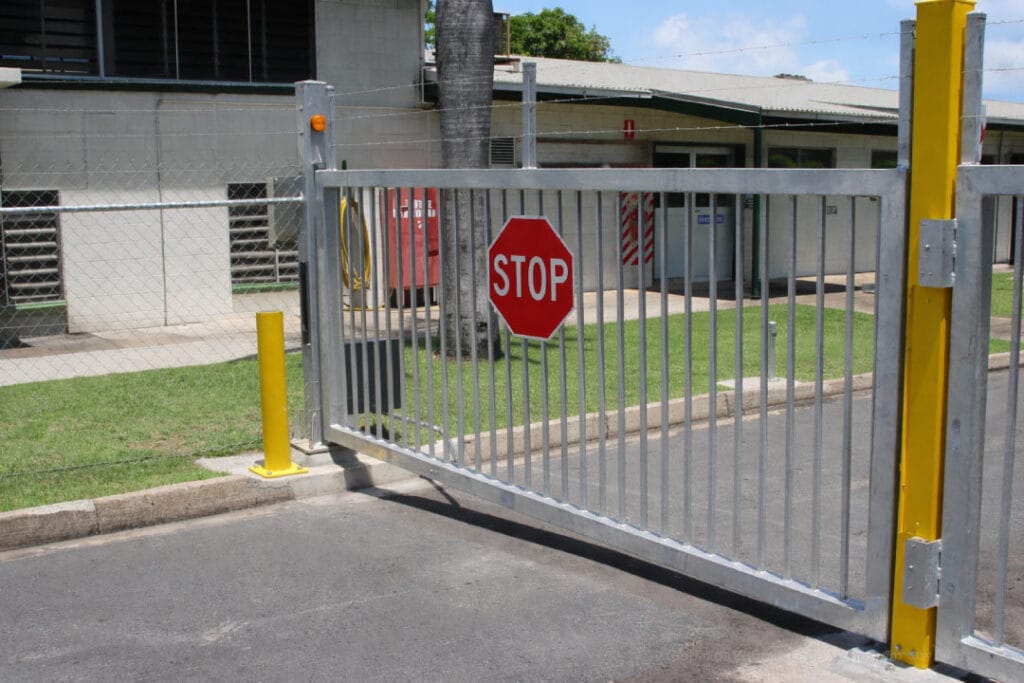
Single Leaf Swing Gates
A single gate panel hinged on one post, swinging in a single arc to open. The most straightforward configuration for commercial entrances, business park entries, and facilities with moderate traffic and a single lane. Single leaf gates suit openings typically up to 4–5 metres wide and are the most cost-effective automated swing gate option.
Best for: Business parks, commercial office entries, smaller warehouse facilities, institutional grounds, and any single-lane commercial entrance with adequate swing clearance.
Dual Leaf (Double) Swing Gates
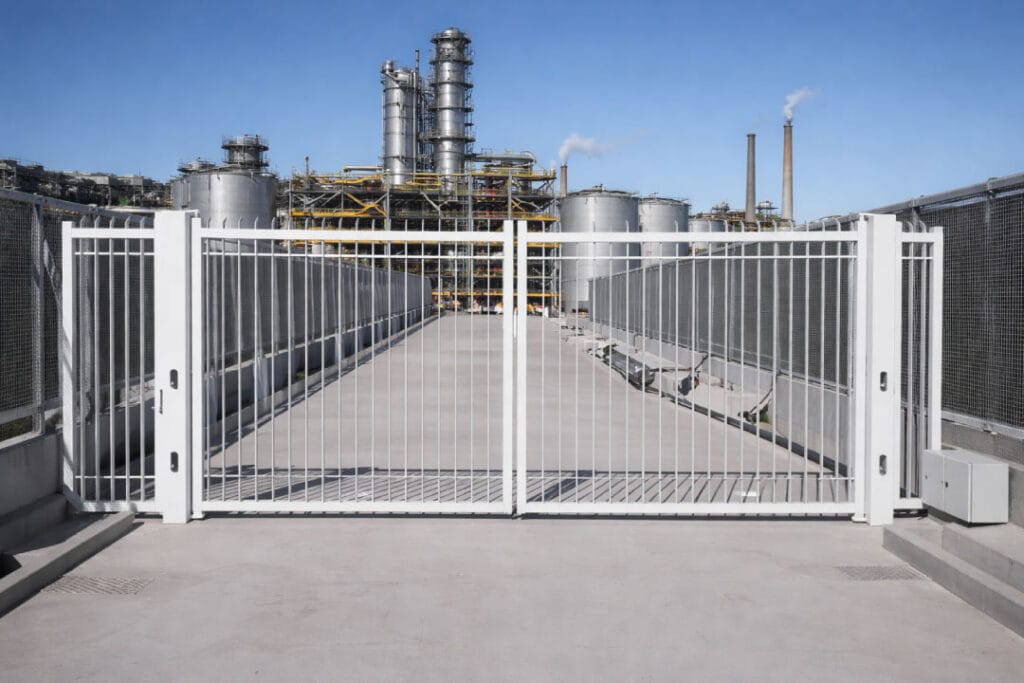
Two gate panels hinged on opposing posts, opening outward or inward from the centre. Required for wider entrances and common in warehouse entries, logistics yards, factory perimeters, and industrial estates where vehicle widths demand a larger clear opening. Each leaf is typically driven by its own motor, operating in a master/slave configuration.
Best for: Wide commercial entrances, warehouse and factory access points, logistics yards, industrial estates, and any site requiring a clear opening wider than a single leaf can practically provide.
Bi-Fold Swing Gates
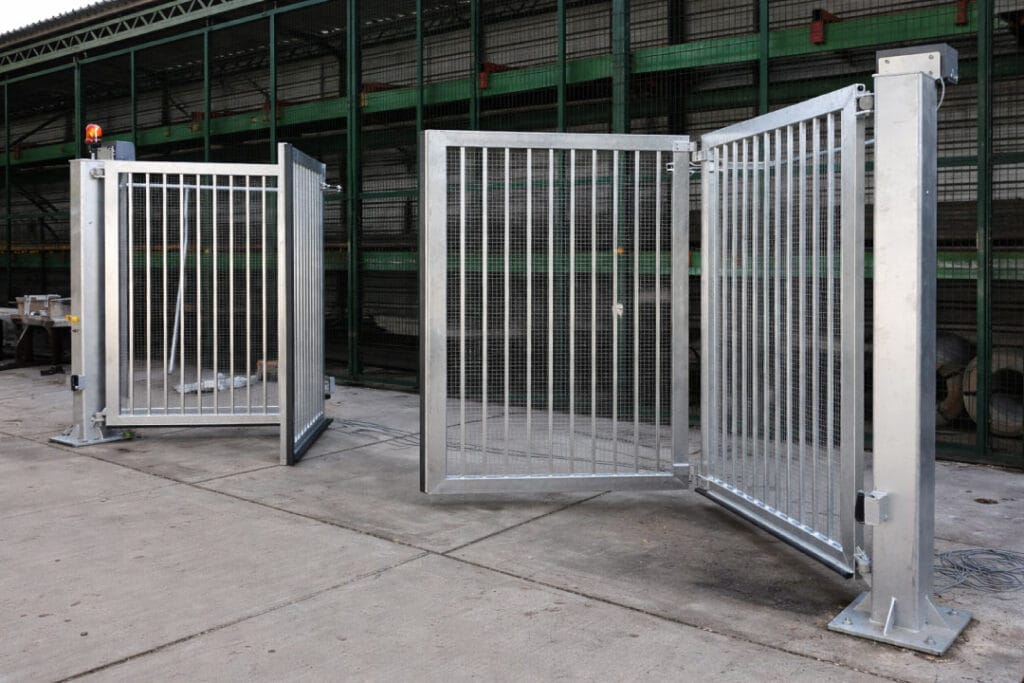
Each gate panel folds in the middle as it opens, reducing the sweep arc required. Useful where the full inward or outward clearance for a standard swing gate isn’t available — for example, where parked vehicles, a footpath, or a building structure limits the available arc.
Best for: Sites with restricted swing clearance on either side of the gate opening.
Inground Motor Swing Gates
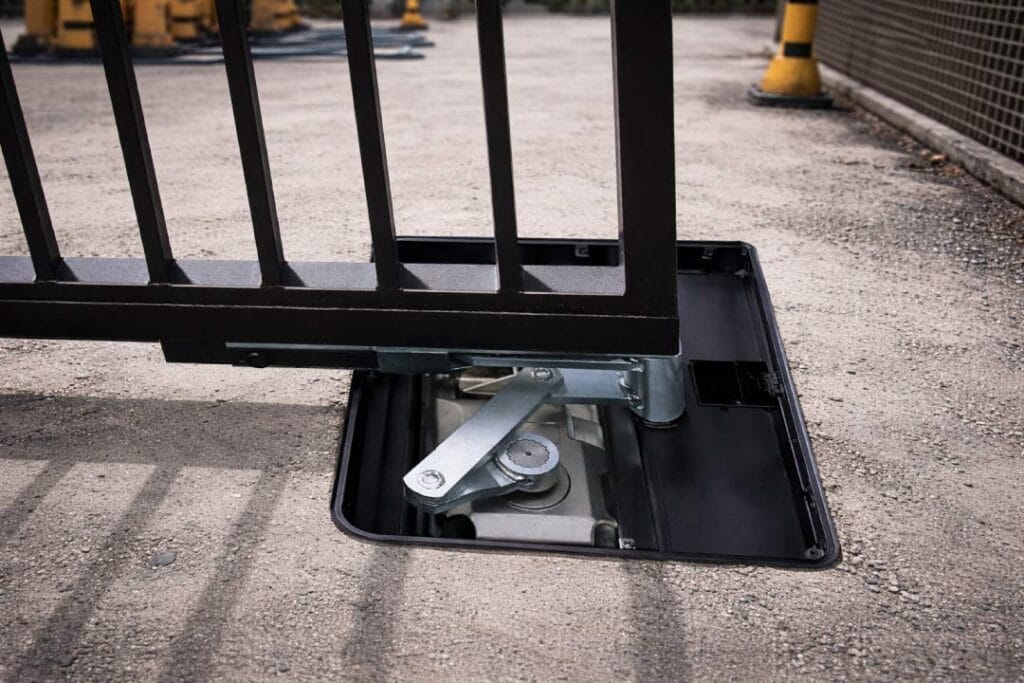
The automation mechanism is concealed beneath the surface at the hinge point, with no visible motor housing or external arm. The gate appears to operate autonomously — aesthetically clean and often preferred for prestige commercial and institutional entrances where visible motor housings would affect the appearance of the entry.
Best for: Prestige commercial entries, institutional facilities, government buildings, embassies, and high-end commercial developments where gate appearance is a priority.
Site Assessment
What We Evaluate
Every commercial swing gate installation starts with a site assessment before any specification or quote is prepared. We assess:
Choosing the Right Swing Gate Motor for Your Application
The motor is the most consequential specification decision for any automatic swing gate. The three main operator technologies, articulated arm, hydraulic, and linear (screw drive), each have distinct performance profiles, weight ratings, duty cycle capabilities, and installation requirements. Getting this wrong means a motor that fails prematurely, a gate that moves too slowly for commercial traffic volumes, or an installation that’s correct on paper but inadequate for the actual conditions.
01
Articulated Arm Operators
The most widely installed swing gate operator type in commercial applications across Australia. A two-part hinged arm attaches to the gate leaf and the gate post or column, pushing and pulling the leaf open and closed as the motor drives the arm through its articulation. Articulated arm systems are typically electromechanical, a motor drives a gearbox which extends and retracts the arm.
Best for: Standard commercial swing gates, single and double leaf applications, gates from light commercial through to medium industrial weight ranges. The most cost-effective option for standard commercial applications. FAAC’s 391 series, BFT’s PHOBOS range, and NICE’s WINGO series are all articulated arm operators commonly installed across Australian commercial sites.
Limitations: The mechanical arm is visible and positioned on the face of the gate post, not suitable where aesthetics require a concealed mechanism. Articulated arm systems also have a defined weight and leaf length limit beyond which hydraulic operators are the more appropriate choice.
02
Linear (Screw Drive) Operators
An electromechanical actuator where a motor drives a threaded rod (screw) in and out of a housing, providing a push-pull force on the gate leaf. FAAC’s 415 and 422 series are typical linear actuators. Linear operators sit between articulated arm and full hydraulic in terms of power and duty cycle capability, more power than most articulated arm systems, lower than hydraulic.
Best for: Medium to large commercial swing gates where articulated arm operators are at or near their rated limit but full hydraulic specification isn’t required. Also used in lower-headroom situations where an articulated arm doesn’t have the clearance to operate correctly.
03
Inground (Underground) Operators
The motor mechanism is concealed below the driveway surface at the hinge point. No visible motor housing or arm, the gate appears to operate with no visible mechanism. Inground systems use either electromechanical or hydraulic technology, with hydraulic inground operators (FAAC 390, BFT IGEA series) preferred for commercial-grade duty cycles.
Best for: Prestige commercial entries, institutional buildings, government facilities, and high-end commercial developments where the appearance of the entry is a priority and visible motor housings are not acceptable.
Motor selection summary
Application | Recommended Operator Type |
Standard commercial, light-medium gate | Articulated arm (electromechanical) |
Heavy commercial / industrial, high-cycle | Hydraulic linear actuator |
Medium commercial, articulated arm at limit | Linear screw drive |
Prestige / concealed requirement | Inground (electromechanical or hydraulic) |
Coastal / harsh environment, any weight | Hydraulic (superior weather resistance) |
04
Hydraulic Operators
Hydraulic linear actuators, where an oil-filled cylinder extends and retracts to push and pull the gate leaf, are the preferred specification for heavy-duty commercial and industrial swing gates. FAAC pioneered hydraulic swing gate automation and their hydraulic range (400 series, 760 series) remains the benchmark for commercial and industrial applications globally.
The advantages of hydraulic over electromechanical are significant for high-duty commercial applications: service life up to four times longer than equivalent electromechanical systems, superior resistance to dust, salt air, and weather exposure, and high power in a compact housing suitable for gate leaves up to 7 metres wide and heavy fabricated steel panels.
Best for: Heavy commercial and industrial gates, high-cycle applications (logistics yards, factory entrances, industrial estates), sites with challenging environmental conditions (coastal, dusty, or hot), and any application where the gate leaf weight or width exceeds the practical range of articulated arm operators.
Commercial note: For strata complexes and commercial entries that cycle many times per day, hydraulic operators are worth the additional upfront cost, their longer service life and lower maintenance requirement typically deliver a lower total cost over a 10-year period than an electromechanical operator that needs replacement at year 5–7.
Access Control Integration
A swing gate automation system is only as capable as the access control inputs connected to it. We design, supply, and configure the full access control solution, not just the gate mechanism.
Brisbane CBD and metropolitan area, Sunshine Coast, Gold Coast, and regional Queensland. Strong presence in industrial estates and commercial facilities across South East Queensland.
Perth metropolitan coverage including Kewdale, Welshpool, Malaga, and surrounding industrial zones. Significant experience with mining-adjacent facilities and heavy industrial access control requirements in WA.
Swing Gates Adelaide and Regional
Adelaide metro coverage and regional locations across SA, NSW, VIC, and QLD. Contact us to confirm availability for your specific location.
Swing Gate Repair & Installation Across Australia
Our installation and service teams are locally based across Australia, not dispatched from a central hub. This means realistic response times and no inflated travel costs for regional sites.

We cover Sydney CBD, inner suburbs, Greater Western Sydney, the North Shore, and the Illawarra. High concentration of work in commercial car parks, strata complexes, hospital facilities, and industrial estates in Western Sydney and South Sydney.
Full metropolitan Melbourne coverage with particular depth in industrial zones: Dandenong, Tullamarine, Laverton, Truganina, Altona, Campbellfield, and Port Melbourne. Logistics, manufacturing, and commercial office park work.
Full ACT coverage including government facilities, university campuses, research institutions, and commercial complexes. We understand the compliance and security requirements particular to Canberra-based installations.
Swing Gates vs Sliding Gates
Which Is Right for Your Site?
This is the most common question facility managers ask when specifying a new gate. The honest answer depends on your site conditions, not a preference.
Choose a swing gate when
- The site has adequate clearance on the inward or outward side for the full arc of the gate leaf
- The ground surface is level and stable
- The entrance width is 4–8 metres and a single or dual leaf can cover it
- The application suits a hinged perimeter gate rather than a barrier
Choose a sliding gate when
- Limited clearance prevents the gate from swinging freely
- The driveway slopes, swing gates on a significant slope require custom engineering
- The opening is very wide and a single swing arc would require very long heavy leaves
- The site is high-security and a gate that can't be pushed open by vehicle force is required
Maintenance and Repair
Swing gate systems require regular maintenance to perform reliably over their service life. The hinge points, arm pivot bearings, motor gearbox, and limit switches are all wear components that degrade without attention. For commercial and industrial sites, we recommend service every 6–12 months depending on cycle volume. A standard maintenance visit covers:
- Safety beam and obstacle detection test
- Control board diagnostic scan
- Access control system function check
- Written condition report
- Hinge and pivot point inspection and lubrication
- Arm or actuator check for wear and correct geometry
- Motor performance test and torque verification
- Limit switch adjustment
For sites with existing swing gate systems that need repair, including systems installed by other contractors, our technicians service all makes and models. We carry parts for major brands on-van and aim to complete most repairs in a single visit.

Get a Fast Quote for Your Swing Gate Repair
Tell us about your site, the location, the application, the approximate traffic volume, and any access control requirements, and we’ll come back with a recommendation and written quote. For larger projects, we’ll arrange a free site visit first.
- 1300 044 400
- hello@nationalco.com.au
- National Entrance Systems
Frequently Asked Questions
How long does a swing gate installation take?
What happens during a power outage?
Can an existing manual swing gate be automated?
How heavy can the gate leaves be?
Do swing gates need council approval?
Swing Gate Maintenance & Repair
Automatic swing gates require regular maintenance to perform reliably through their service life. A swing gate cycling 30 times per day, typical for a strata complex or commercial office entry, accumulates over 10,000 cycles per year. Hinge wear, motor and actuator wear, limit switch drift, and safety device calibration all require periodic attention.
Recommended maintenance intervals:
- High-cycle commercial / strata (50+ cycles/day): every 6 months
- Standard commercial (10–50 cycles/day): annually
- Light commercial / institutional (under 10 cycles/day): every 18 months
Common swing gate faults we repair:
Motor and actuator failure: slow or laboured gate movement, grinding during operation, the gate stopping mid-travel, or complete loss of movement. Electromechanical motors fail at predictable intervals; hydraulic operators fail less frequently but require oil and seal inspection at service intervals.
Hinge wear: swing gates put significant load on their hinges with every cycle. Worn hinges allow the gate to sag, changing the geometry of the motor arm attachment and eventually causing motor strain and arm component wear. Hinge inspection and replacement is part of every maintenance visit.
Limit switch and encoder faults: limits tell the motor where to stop. When they drift, the gate doesn’t open fully (frustrating for wide vehicle clearance) or overshoots its closed position (motor strain and potential locking mechanism damage).
Safety device faults: obstacle detection, safety beams, and safety edges on swing gates must function correctly. A gate that doesn’t detect an obstruction and doesn’t reverse is a WHS compliance failure and a liability risk.
Access control integration faults: RFID reader failures, remote control issues, loop detector faults, intercom communication problems. Often the gate mechanics are fine but the trigger mechanism has failed.
We service and repair swing gate systems across Australia, all brands, regardless of who originally installed them.
We Work with the World’s Most Trusted Brands
We partner with leading manufacturers to ensure every installation, repair, and upgrade meets global quality and reliability standards.