Introduction
Auto sliding gates are the most widely installed automated gate type across Australian commercial and industrial sites, and also the most frequently misspecified. The gap between a sliding gate that runs reliably for ten years and one that burns through motors every two years almost always comes down to decisions made before installation: gate type, motor duty cycle rating, rack specification, and whether the site conditions actually suit a track-mounted system or require a cantilever.
This guide covers everything facility managers, strata managers, and commercial operators need to know about auto sliding gates, how each type works, how to select the right motor, what they cost to install, what goes wrong, and how to keep them running.
How Auto Sliding Gates Work
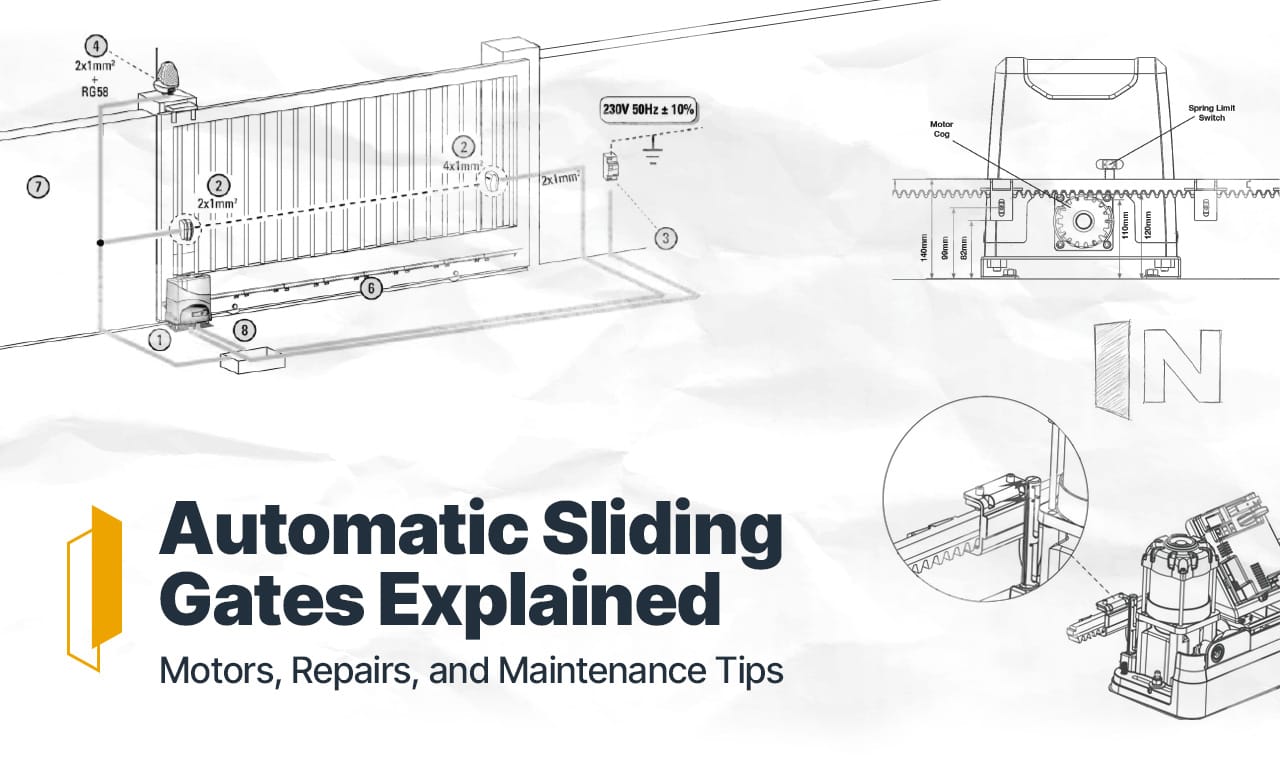
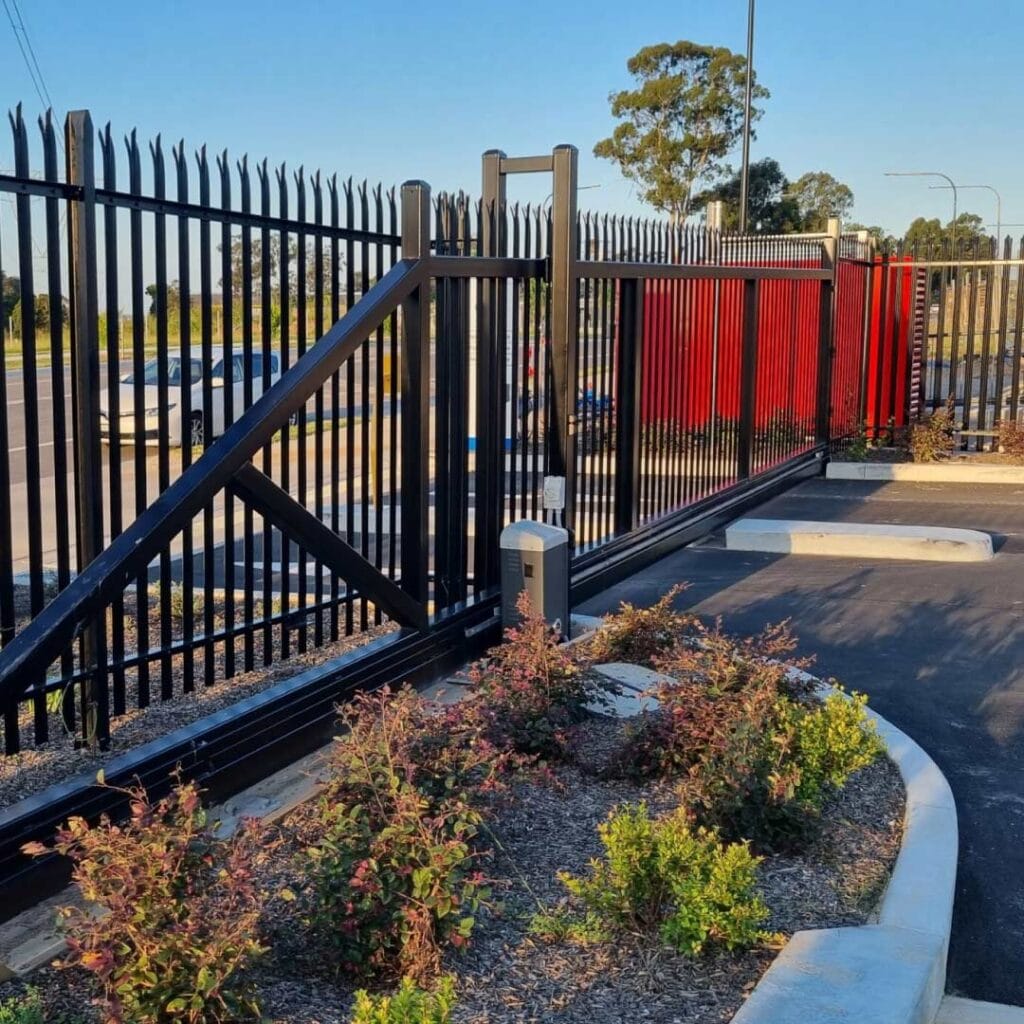
An auto sliding gate moves a steel panel horizontally across the opening rather than swinging on hinges. The panel is driven by an electric motor that engages a toothed rack welded or bolted along the gate’s underside. As the motor’s drive gear (the pinion) rotates, it moves along the rack and pulls or pushes the gate panel across the opening.
The gate is triggered by remote control, RFID card, keypad entry, vehicle detection loop, intercom, or an integrated access control system. Safety sensors, photocell beams across the opening and a safety edge on the leading edge of the gate, prevent the gate from closing on a vehicle or person. When the trigger signal is received, the control board commands the motor to run in the appropriate direction until the limit switch signals that the gate has reached its open or closed position.
The full system: gate panel, rack, motor and gearbox, control board, limit switches, safety devices, and access control trigger. Each component has specific wear characteristics and failure modes, understanding them is what separates reactive repair costs from scheduled maintenance costs.
Types of Auto Sliding Gates
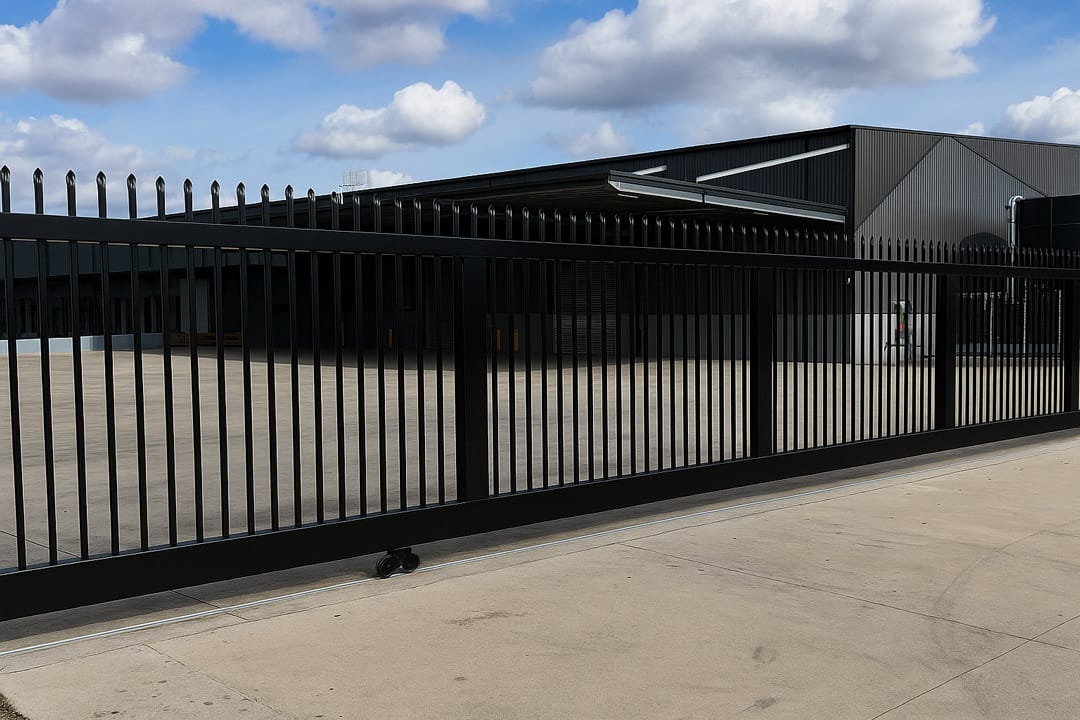
Track-Mounted Sliding Gates
The gate panel runs on a steel ground track installed along the length of the gate’s travel path. The track guides the bottom of the gate panel through rollers mounted to the bottom rail, while the top of the panel is guided by a nylon or steel guide rail on a post at the opening edge.
Best suited for: Sealed driveways with a level, stable surface. Commercial office entries, strata car park entries, and industrial sites with concrete or asphalt driveways that remain stable under vehicle crossings.
Limitations: The ground track is the single most vulnerable component of a track-mounted system. Heavy vehicle crossings, particularly trucks repeatedly crossing the track at an angle, loosen track mounting, crack the surrounding surface, and allow debris to accumulate in the track channel. On unsealed, gravel, or variable-surface entries, a track-mounted gate will require constant track maintenance and is ultimately the wrong specification for the site.
Cantilever Sliding Gates
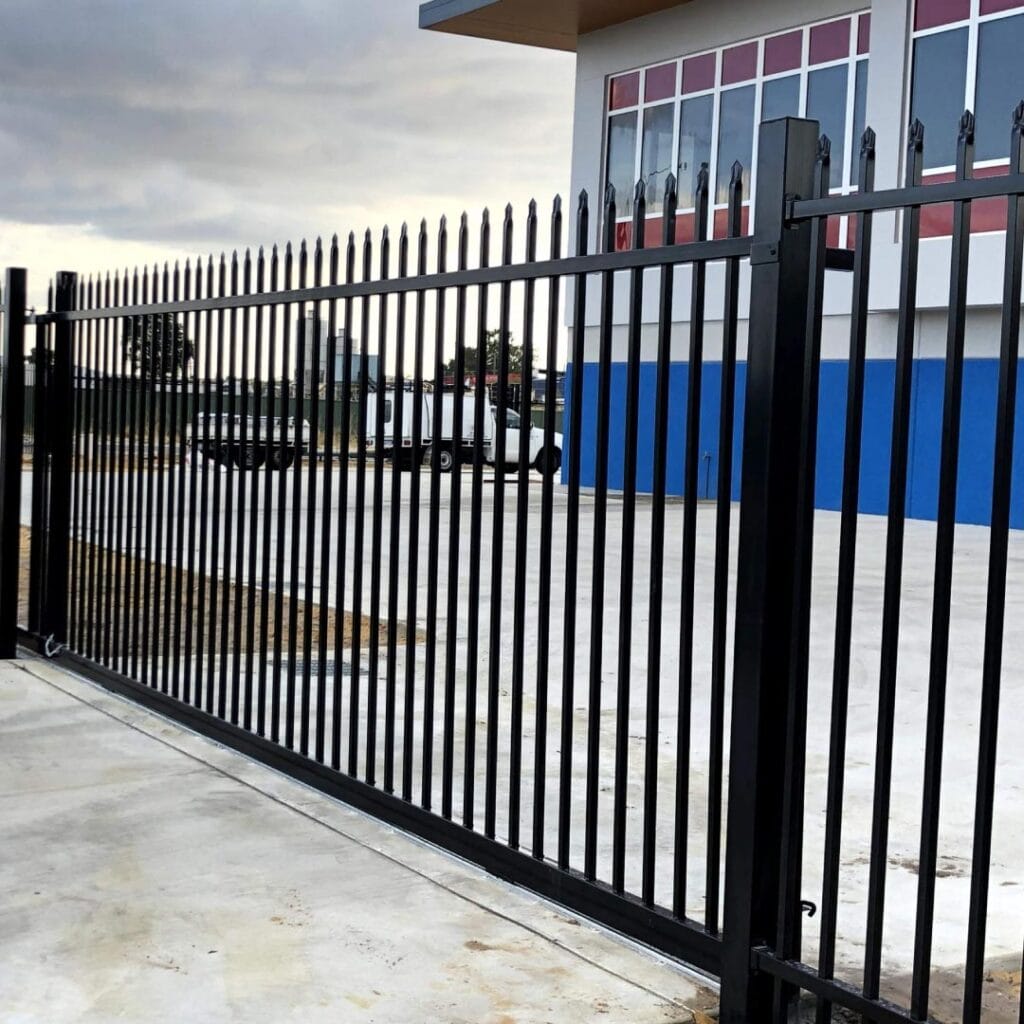
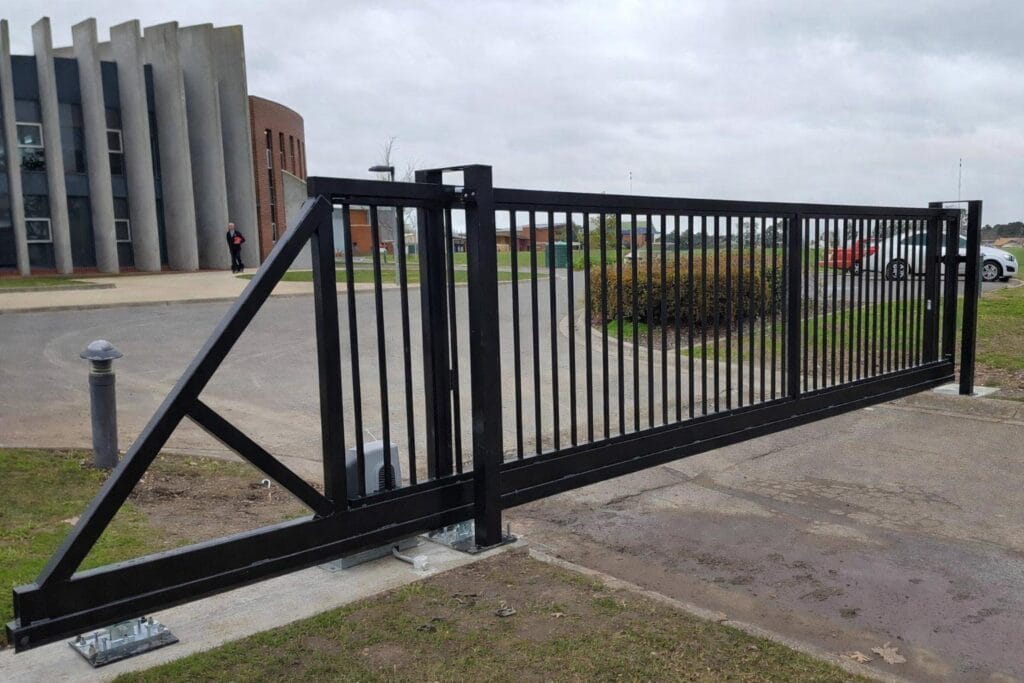
The gate panel is suspended above the ground on rollers mounted to posts on the non-opening side. No ground track. The panel is counterweighted, the portion of the gate that extends behind the posts when open balances the span across the opening. The gate floats above the surface, guided only by the rollers and a top guide at the opening edge.
Best suited for: Industrial sites with unsealed or gravel surfaces, sites with heavy vehicle traffic that would damage a ground track, and any entry where surface conditions prevent reliable track installation. Cantilever gates are the dominant specification across Australian industrial estates for precisely these reasons.
Limitations: Cantilever gates require additional run-back space on the non-opening side, typically 1.5× the gate width, for the counterbalance extension. Post footings must be engineered for the gate panel weight and local soil conditions. On sandy or clay soils common across many Australian industrial areas, inadequate footings allow post movement that throws the gate out of alignment.
Cantilever gate repair: Cantilever systems have specific failure modes distinct from track-mounted gates. Roller wear causes the gate panel to drop progressively, the gap between the gate bottom and the ground increases until the gate’s security function is compromised. Post movement affects gate alignment and creates motor strain. We repair cantilever gates across all major Australian cities including “cantilever gate repair Sydney”, one of the most frequently searched cantilever repair queries in the country.
Telescopic Sliding Gates
Multiple panels slide and telescope (overlap and stack) as the gate opens, allowing a wide clear opening from limited run-back space. Where a standard 6-metre single-panel gate requires 6+ metres of run-back clearance, a two-panel telescopic system achieves the same clear opening with approximately 3.5 metres of run-back.
Best suited for: Urban commercial sites and established industrial properties where driveway length limits run-back availability, but a wide vehicle opening is required. Loading dock entries flanked by buildings on both sides are a typical telescopic gate application.
Limitations: The synchronisation linkage between panels adds mechanical complexity and requires more frequent maintenance than single-panel systems. Any misalignment in the panel linkage creates binding and uneven motor load.
Auto Sliding Gate Motors
How to Choose
Motor selection is the most consequential specification decision for any auto sliding gate. The wrong motor creates problems that can’t be resolved without replacement, no amount of maintenance fixes an undersized motor on a high-cycle industrial gate.
Key Selection Criteria
Gate panel weight: Every sliding gate motor has a maximum rated gate weight. Exceeding it overloads the motor on every cycle. Get the gate panel weighed, don’t estimate.
Daily cycle volume: Motors are rated in cycles per day or cycles per hour. A motor rated for 100 cycles per day running 250 cycles per day on a busy logistics entry reaches end of life in a fraction of its rated service life. Count actual vehicle movements for a representative day before specifying.
Duty cycle: Related to cycle volume, duty cycle is the percentage of time the motor is actively running. High-duty cycle applications (where the gate is opening and closing continuously throughout the day) require motors with higher thermal ratings and more robust internal components.
Gate width and panel span: Wider gates create greater mechanical load on the motor, particularly on cantilever systems where the motor must manage the inertia of a large suspended panel. Motor torque rating must be matched to the panel span.
Motor Brands
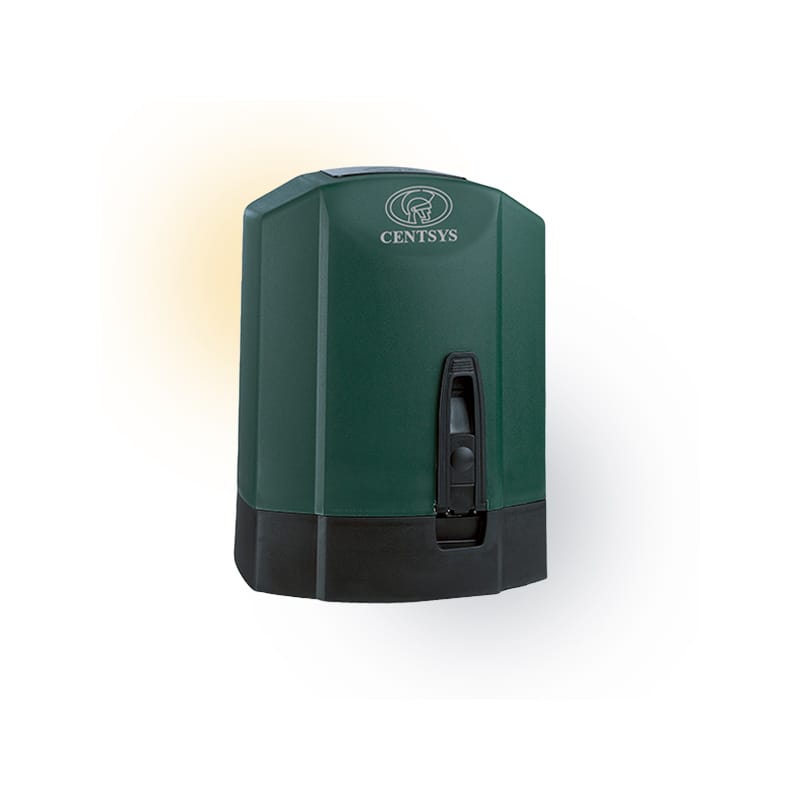
Centsys (Centurion Systems) is the most widely installed sliding gate motor brand across Australian commercial and industrial sites. The D5 Evo (500kg, standard commercial), D10 (1,000kg, heavy commercial), and D20 (2,000kg, industrial) cover the full range of Australian commercial applications. Centsys motors are known for their robust control boards, integrated diagnostics, and strong parts availability through the Australian distribution network.
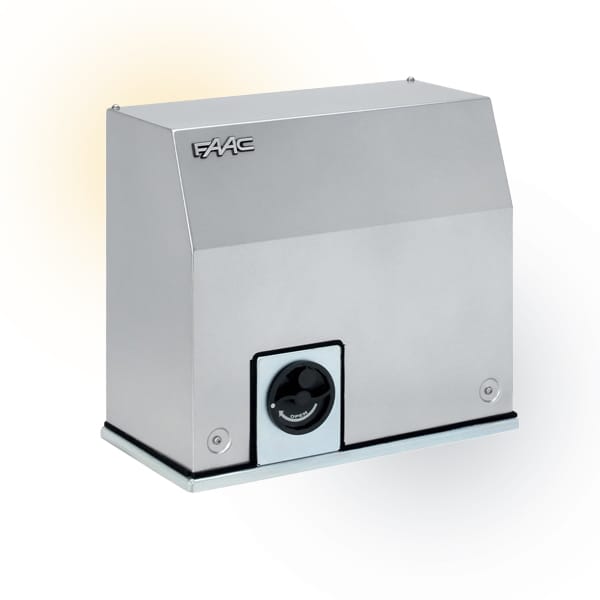
FAAC offers the 844 ER and 746 ER series, Italian-engineered operators with oil-bath gearboxes designed for long service life and continuous-duty industrial applications. FAAC is the preferred specification for very heavy gate panels and high-cycle sites where maximum service life is the priority. The oil-bath gearbox requires periodic oil changes but delivers significantly longer gear life than grease-lubricated alternatives.
DEA produces the GULLIVER and LIVI series, oil-bath gearbox operators with integrated control boards well-suited to commercial and heavy-duty applications. Less widely distributed than Centsys or FAAC in Australia but well-regarded for reliability in demanding environments.
BFT offers the ICARO series, capable commercial sliding gate operators with smart control integration options. Common across strata and commercial property installations.
Roger Technology produces brushless motor sliding gate operators, the B70 and R30 series. Brushless motor technology delivers longer motor service life than brushed alternatives and more consistent performance across temperature variations. Specified for high-cycle commercial applications where motor longevity is a priority.
Application | Recommended Motor Range |
Standard commercial, up to 500kg, under 100 cycles/day | Centsys D5 Evo, BFT ICARO |
Heavy commercial, 500–1,000kg, up to 200 cycles/day | Centsys D10, DEA GULLIVER |
Industrial, 1,000–2,000kg, continuous duty | Centsys D20, FAAC 746 ER |
Very heavy industrial, 2,000kg+, continuous duty | FAAC 844 ER |
High-cycle, motor longevity priority | Roger Technology B70 (brushless) |
Common Auto Sliding Gate Faults and How to Fix Them
Gate Not Opening or Closing
Most likely causes: Power supply fault (check that the motor’s power indicator is on before diagnosing further); control board fault (the board is receiving power but not commanding the motor); limit switch fault (the board thinks the gate is already at the commanded position); access control fault (the trigger signal isn’t reaching the control board).
What not to do: Don’t repeatedly send open or close commands when the gate isn’t responding, if the gate is jammed mechanically, forcing repeated motor activation can burn the motor.
When to call a technician: Immediately if the motor is unresponsive and the power supply is confirmed normal. Control board faults, limit switch replacement, and wiring faults all require a technician.
Gate Stops Midway Through Travel
Most likely causes: Obstruction detection triggered (a photocell beam has detected something in the gate’s path, check the opening is clear, then check beam alignment); limit switch drift (the gate is stopping where the limit tells it to, but the limit has moved); mechanical binding (debris in the track, roller seizure, or rack misalignment creating resistance that triggers the motor’s overload protection).
Quick check: After the gate stops mid-travel, try closing it manually using the motor’s manual release. If it moves freely by hand, the fault is electronic, obstruction detection or limit switch. If it’s stiff or jammed, the fault is mechanical.
Grinding or Clicking During Operation
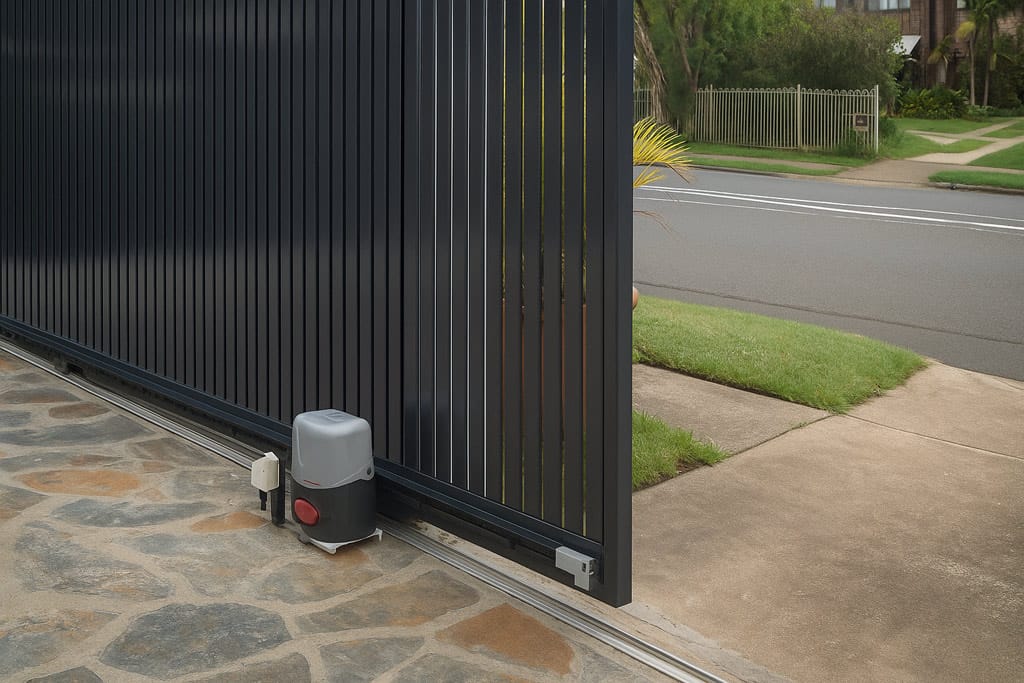
Most likely causes: Worn rack teeth, when rack teeth wear, the pinion skips across the worn sections, producing a clicking or knocking sound. Worn roller bearings, a grinding or rumbling sound that changes with gate speed. Debris in the track channel (track-mounted systems), small stones and compacted material produce grinding as the gate passes over them.
Why it matters: Grinding from worn rack teeth isn’t just noise, the pinion is hammering against irregular tooth surfaces on every rotation, accelerating wear on both the rack and the pinion gear. Addressing rack wear early is significantly cheaper than replacing both the rack and the motor gearbox.
Motor Running but Gate Not Moving
Most likely causes: Rack and pinion disengagement, the pinion has worn enough that it no longer engages the rack reliably and is slipping rather than driving; manual release engaged, the motor’s manual release has been activated (accidentally or during a power outage) and not re-engaged; mechanical jam, something is physically preventing the gate from moving despite the motor running.
Safety Device False Triggering
Most likely causes: Photocell beam misalignment, the transmitter and receiver are no longer pointed at each other accurately, causing the beam to drop and the control board to register a phantom obstruction. This is extremely common after nearby construction, cleaning near the gate posts, or any physical change in the gate post environment. Dirty photocell lenses, dust, spider webs, or condensation on the lens surface interrupts the beam. Electrical interference from nearby equipment affecting the safety edge signal.
Slow Gate Operation
Most likely causes: Motor wear, internal component wear reduces the motor’s output torque; spring and roller friction, worn rollers or debris in the track increase the mechanical load the motor must overcome; motor specification, the gate was always undersized for the actual load and is getting progressively worse as internal wear compounds the problem.
What a Full Service Visit Covers
Mechanical inspection:
- Rack condition: tooth wear depth, corrosion, secure mounting along full length
- Pinion gear condition: tooth wear and engagement quality with rack
- All rollers: wheel condition, bearing noise, axle wear
- Ground track alignment and debris clearance (track systems)
- Cantilever post condition and mounting hardware (cantilever systems)
- Gate panel alignment: plumb, square, bottom clearance, top guide engagement
All hardware, end stops, limit adjusters, mounting brackets
Lubrication:
- Rack lubrication with appropriate grease (not WD-40, a penetrant, not a lubricant)
- Roller bearings
- All pivot points and moving hardware
Motor and automation:
- Motor performance test: current draw under load, operating temperature, noise
- Control board diagnostic scan and fault log review
- Limit switch verification and adjustment
- All safety devices: photocell beams and safety edges, function tested individually
- Access control device test across all configured methods
- Battery backup test where fitted
Get a Fast Quote for Your Sliding Gate Repair
Tell us about your gate, the brand, symptoms, and your location, and we’ll come back to you with a clear, no-obligation quote. For urgent faults, call us directly for priority scheduling.
- 1300 044 400
- hello@nationalco.com.au
- National Entrance Systems