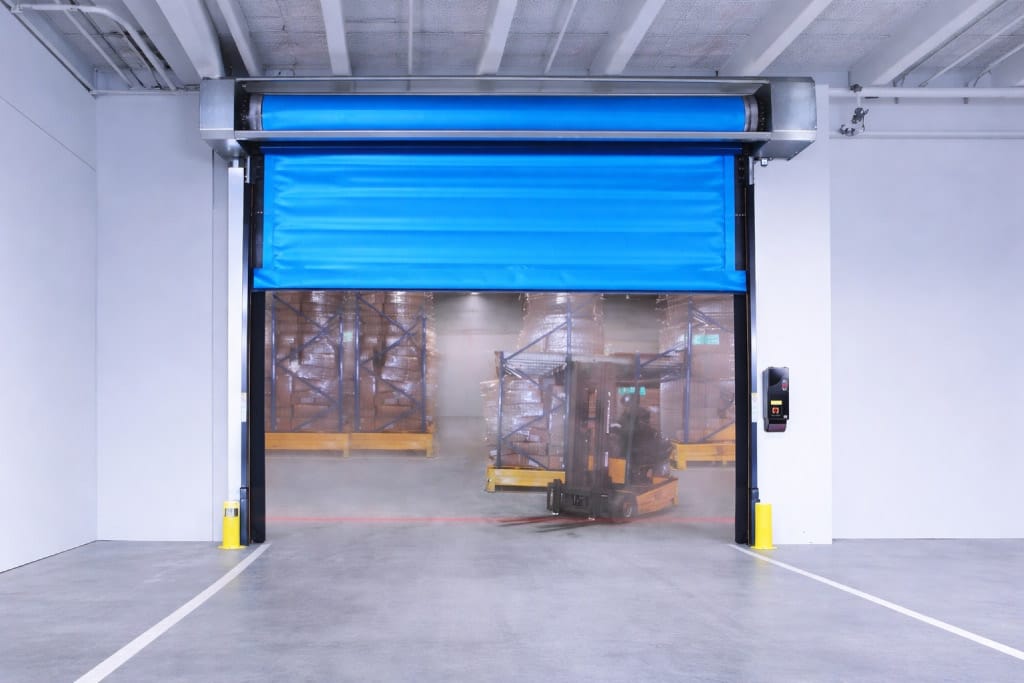
A rapid door opens and closes significantly faster than a standard roller door or sectional door, typically in 0.5 to 2 seconds, compared to 8 to 15 seconds for a standard commercial roller door. In a warehouse or food processing facility where a door opens and closes hundreds of times per day, the difference between a 1 second cycle and a 10 second cycle is the difference between a system that flows with operations and one that creates a bottleneck at every access point.
Rapid doors are specified when standard doors are too slow for the operational environment, when temperature or contamination control at an internal access point requires the door to open and close before heat transfer or particulate ingress becomes a problem, or when the sheer volume of forklift and pedestrian movements makes a slow door an obstacle to productivity.
What Is a Rapid Door?
A rapid door is a high-speed automated door designed for frequent cycling at access points in commercial and industrial environments. Unlike a standard roller door, which is designed for occasional operation at building perimeter access points, a rapid door is engineered for internal and semi-internal access points that cycle continuously throughout an operational shift.
The key characteristics: open speed typically 0.5–2.0 m/s (versus 0.1–0.2 m/s for standard roller door), self-repairing curtain systems on most models (the door resets itself after impact rather than requiring a technician to re-rail the curtain), robust construction designed for high daily cycle counts, and integrated safety systems that stop or reverse the door on detecting an obstruction.
Types of Rapid Doors
PVC Rapid Roll Doors
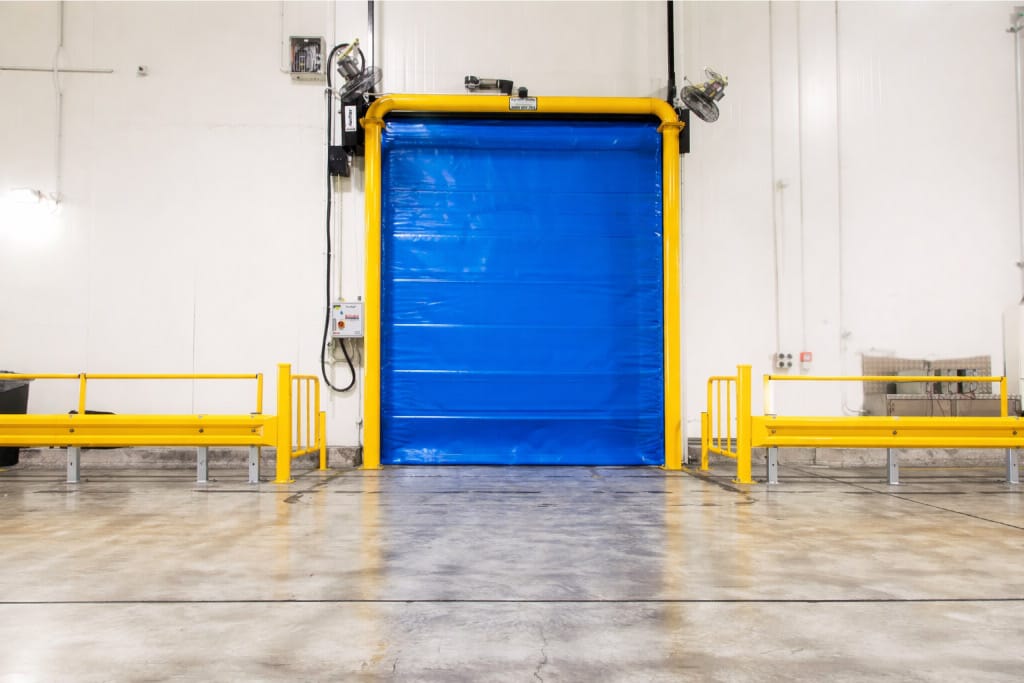
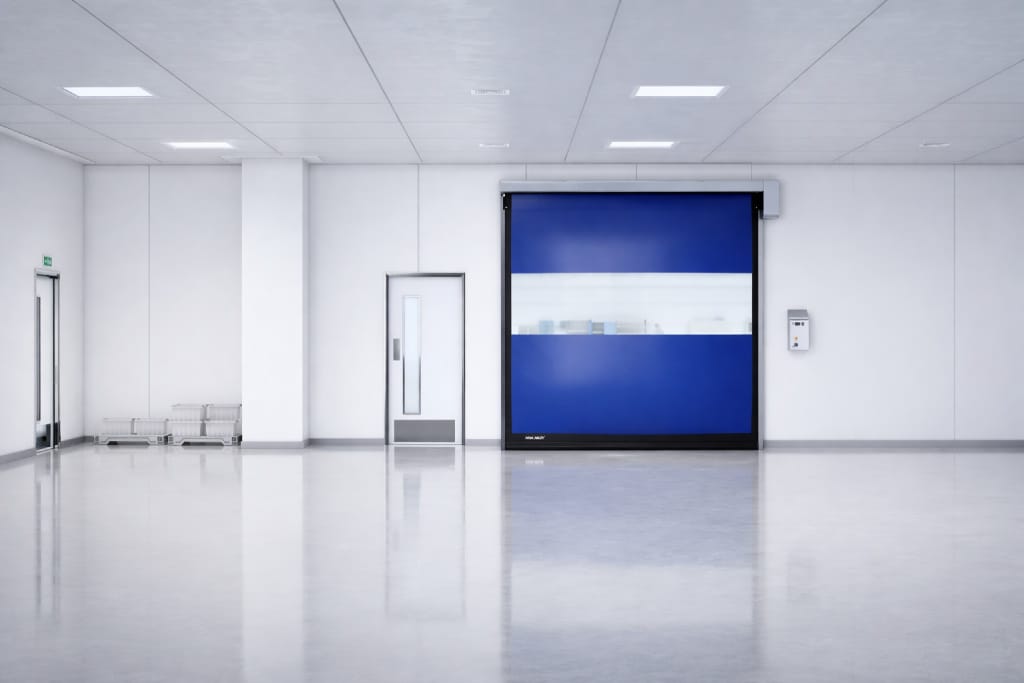
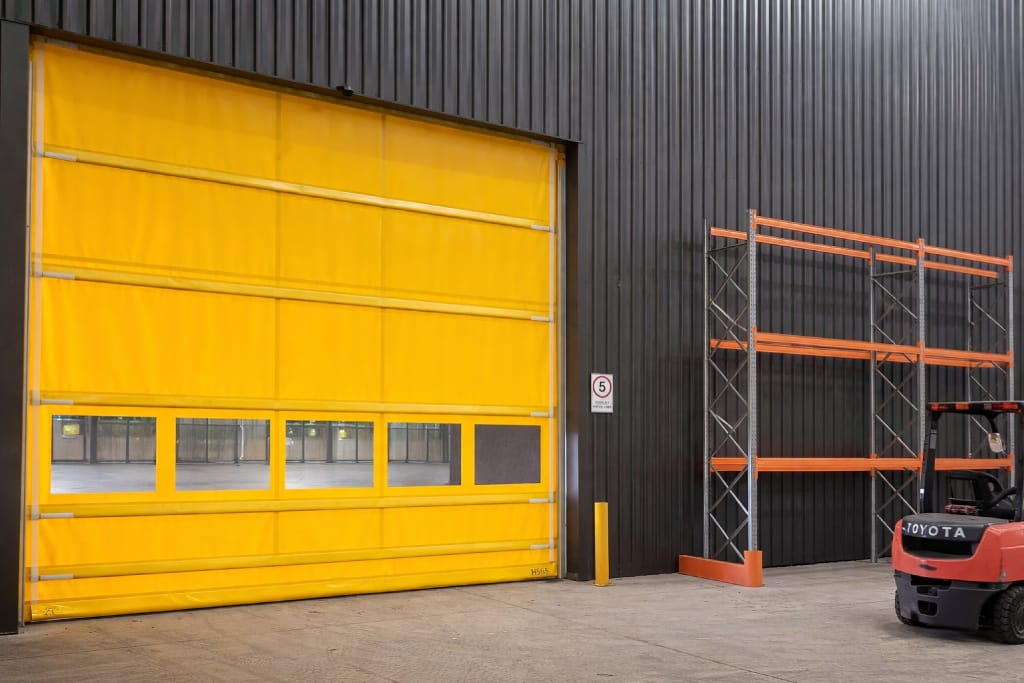
The most widely installed rapid door type across Australian commercial and industrial sites. A flexible PVC curtain winds around a barrel above the opening — the curtain is typically 0.8–2mm thick PVC, either transparent or with transparent vision panels, in a range of colours. The flexibility of the PVC curtain is the key feature: when a forklift or vehicle contacts the door, the curtain deflects rather than breaking, and the self-repairing mechanism re-engages the curtain into its guide rails automatically.
Applications: Warehouses and distribution centres (internal access between zones), cold storage and refrigerated facilities (minimising temperature transfer between zones), food processing (minimising contamination and maintaining environmental control), pharmaceutical and cleanroom environments (maintaining positive pressure and particulate control), car parks and covered entries where weathering of a standard roller door isn’t required.Cycle speed: Typically 0.8–1.5 m/s open speed. A PVC rapid roll door can complete 1,000–2,000 cycles per day without issue when correctly specified and maintained, a figure that would destroy a standard commercial roller door in a matter of months.
Rigid Panel High-Speed Doors
A high-speed door with a rigid steel or aluminium panel rather than a flexible curtain. Opens by the panel folding upward or sliding horizontally at high speed. Provides greater security, better thermal insulation, and better wind resistance than a PVC curtain door, at higher cost and with greater mechanical complexity.
Applications: External access points requiring both high speed and substantial security or thermal performance. Loading dock doors on temperature-controlled facilities where a flexible PVC curtain’s insulation value is insufficient. High-wind locations where a flexible curtain would be affected by wind loading.
Spiral and Folding High-Speed Doors
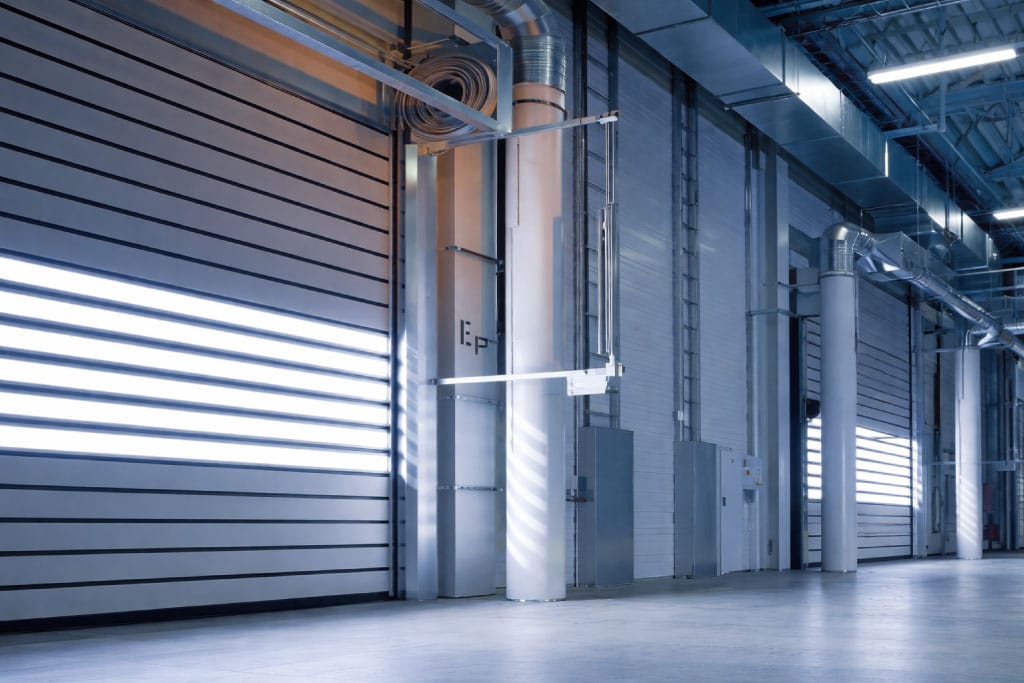
Rigid slat or panel doors that spiral upward into a compact barrel at very high speed, 1.5–2.5 m/s, faster than most PVC curtain doors. The spiral mechanism allows the door to open and close faster than a standard rolling or folding system with less barrel overhang above the opening.
Applications: High-throughput internal access points where maximum speed is the primary requirement and the compact barrel profile suits a constrained installation space. Common in automotive manufacturing, aviation maintenance facilities, and high-volume logistics operations.
Fabric Rapid Doors
High-speed doors with a fabric (typically polyester or fibreglass-reinforced PVC) curtain for applications requiring specific properties beyond standard PVC, higher thermal insulation, chemical resistance, FDA-compliance for food contact, or specific colour and branding requirements.
Where Rapid Doors Are Specified in Australia
Cold Chain and Refrigerated Facilities
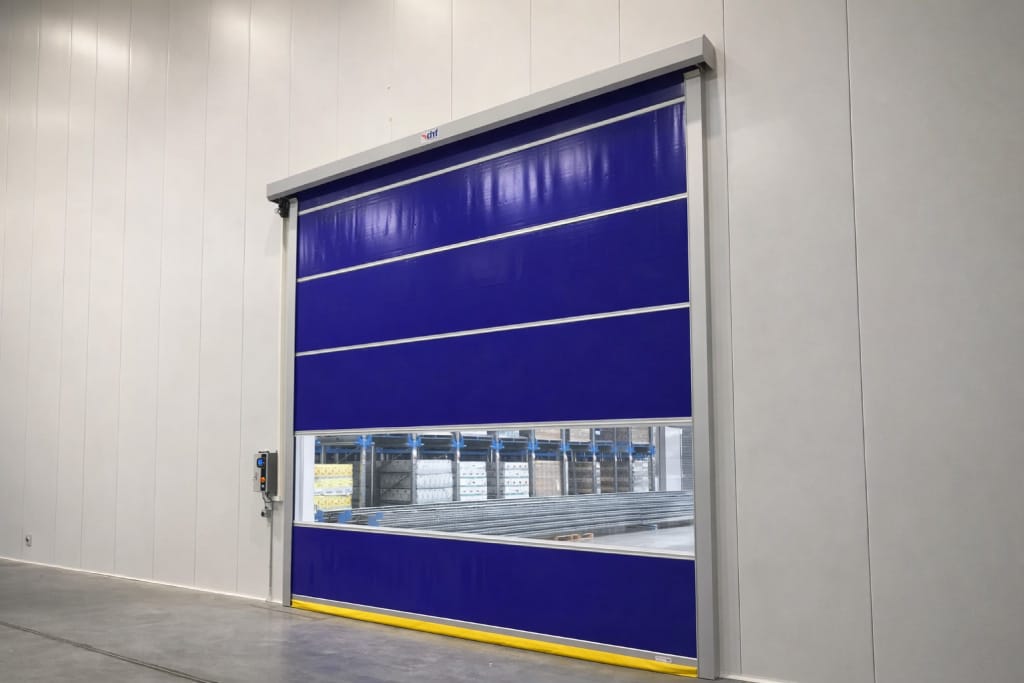
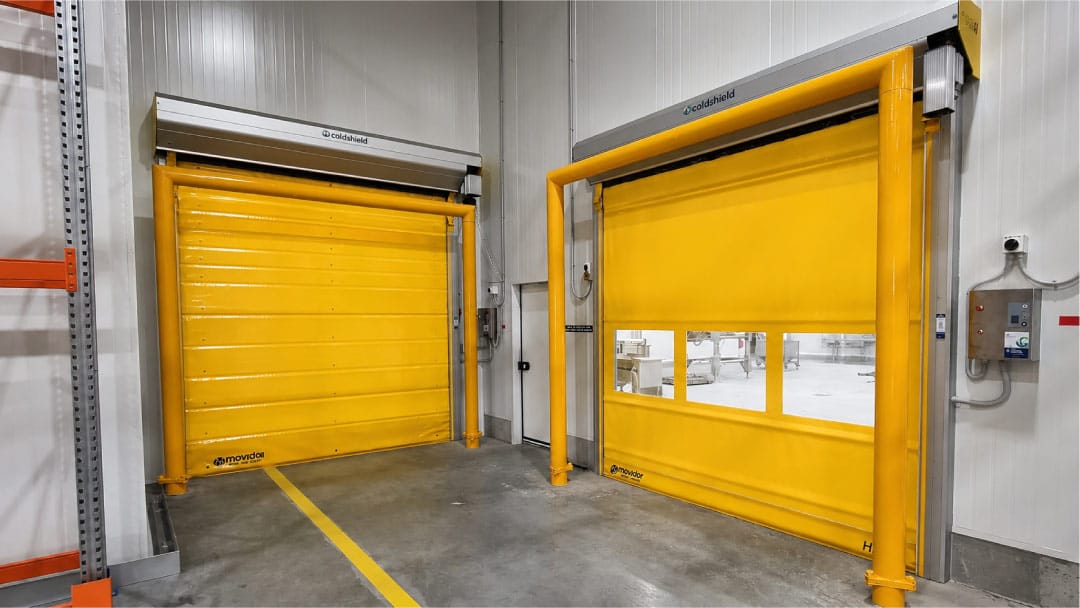
The most performance-critical rapid door application. Every time a door opens at the entry to a cold room or freezer, refrigerated air escapes and ambient air enters. At a standard roller door open speed, the temperature transfer in a single cycle is significant, in a facility cycling hundreds of times per day, the cumulative refrigeration load from slow doors is measurable in energy costs.
A rapid door at a cold room entry opens and closes fast enough to substantially reduce temperature transfer per cycle. The energy saving over the lifetime of the door typically exceeds the purchase and installation cost, making rapid doors on cold room entries one of the better-documented ROI investments in commercial refrigeration facility equipment.
Food Processing and Pharmaceutical
Environmental control, preventing cross-contamination between processing zones, maintaining positive pressure in controlled areas, and keeping pests, insects, and particulates out of clean areas, requires doors that close quickly enough to function as effective barriers rather than temporary openings. Standard roller doors, which take 8–15 seconds to close, are often inadequate for this function. A rapid door that closes in 1–2 seconds is a meaningful barrier.
Specific food industry considerations: self-repairing curtain systems prevent the damage and curtain debris that a rigid door suffers on forklift impact; transparent PVC allows vision through the door without opening it; and the curtain materials on food-grade rapid doors are specified to be non-toxic, cleanable, and resistant to the chemicals used in food processing wash-downs.
Warehouses and Distribution Centres
High-volume warehouses where forklifts and pallet walkers move continuously between internal zones benefit from rapid doors in two ways, operational flow (forklifts don’t wait for doors to open and close) and temperature control (where zones are at different temperatures). The self-repairing curtain is particularly important in warehouse environments where forklift contact with the door is inevitable.
Car Parks and Covered Entries
Rapid doors at commercial car park entries and covered loading bays where fast cycling reduces vehicle queuing without the security compromises of a door that stays open for extended periods.
Rapid Door Maintenance
Rapid doors cycle at rates that make maintenance more critical than for any other door type. A rapid door cycling 500 times per day accumulates over 180,000 cycles per year. At that rate, every wearing component — curtain guide seals, curtain bottom rail, drive motor and gearbox, limit switches, safety sensors, experiences wear that needs to be assessed and addressed at regular intervals.
Common Rapid Door Faults
Curtain de-railing: the curtain has come out of its guide rails. On self-repairing system, this should resolve automatically when the door cycles; if the self-repair mechanism isn’t engaging correctly, a technician visit is required to identify why.
Curtain damage: tears, holes, or impact damages to the PVC curtains. Small tears in PVC curtains can be repaired with PVC repair patches. Larger damage or structural tears require curtain section or full curtain replacement.
Motor and drive failure: slow operation, grinding noise, stopping mid-cycle, or complete failure to respond. Rapid door motors have higher cycle counts than any other commercial door motor type and wear accordingly. Correct motor specification for the door’s actual daily cycle volume is critical.
Safety sensor faults: photocell beams and safety edges that prevent the door closing on a person or vehicle. False triggering (the door won’t close because the sensor detects a phantom obstruction) is the most frequent safety sensor fault. Dirty sensor lenses and misalignment are the most common causes.
Control board faults: erratic operation, error codes, responding inconsistently to trigger signals. Control board degradation on rapid doors is accelerated by the vibration of high-cycle operation.
Curtain guide seal wear: the seals on the guide rails that contact the curtain edges on every cycle wear progressively. Worn guide seals allow air, dust, and contaminants to pass through the guide channel, compromising the environmental control function the door is installed to provide.
Recommended Maintenance Intervals
| Usage | Cycles Per Day | Service Interval |
| Very high cycle | 500+ | Every 3 months |
| High cycle | 200–500 | Every 6 months |
| Standard commercial | 50–200 | Annually |
What a Rapid Door Service Visit Covers
- Curtain condition inspection — tears, holes, UV degradation, edge seal wear
- Guide rail inspection — alignment, guide seal condition, fastener torque
- Bottom rail condition and floor contact
- Drive motor performance — current draw, operating temperature, noise assessment
- Gearbox inspection and lubrication
- Limit switch verification and adjustment
- All safety devices — photocell beams and safety edges — function tested
- Self-repair mechanism function test
- Control board diagnostic scan
- Access trigger test across all configured methods
- Written condition repor
Where We Install and Service Rapid Doors
National Entrance Systems installs, repairs, and maintains rapid doors across Australia. Our technicians are locally based in every major city:
Sydney: cold chain and food processing facilities across Western Sydney, warehouse and distribution rapid door service across the South West logistics corridor
Melbourne: rapid roller doors across Melbourne’s south-eastern and western industrial corridors; cold chain facilities across the food processing precincts of Dandenong and Laverton
Perth: rapid doors across Kewdale, Welshpool, Henderson, and key Perth industrial precincts
Brisbane: rapid door installation and repair across Brisbane metro and South East Queensland
Canberra: rapid doors for government, institutional, and industrial facilities across the ACT
Adelaide, Newcastle, Hobart, Darwin: coverage across all major commercial and industrial locations
Frequently Asked Questions
What is the difference between a rapid door and a standard roller door? Speed, duty cycle, and application. SStandard roller door opens at 0.1–0.2 m/s and is designed for infrequent operation at perimeter access points. A rapid door opens at 0.8–2.5 m/s and is designed for continuous operation at internal access points where speed matters for operational flow and environmental control. The two door types serve different purposes and shouldn’t be substituted for each other.
Do rapid doors need more maintenance than standard roller doors? Yes. The cycle counts involved, often 200-1,000+ per day — mean that wearing components accumulate wear at rates that require more frequent inspection and replacement. A well-maintained rapid door delivers excellent service life; a poorly maintained one fails frequently and expensively.
What happens when a forklift hits a rapid door? On self-repairing rapid doors (the most common type in Australian commercial and industrial applications), the curtain is designed to deflect on impact and re-engage automatically in the guide rails when the door cycles. In most cases, a forklift impact on a self-repairing door results in no downtime — the door resets itself. Severe impacts can damage the bottom rail or the guide rail entry, which requires a technician visit.
How long does a rapid door last? A correctly specified and regularly maintained rapid door typically delivers 8–12 years of reliable service. High-cycle applications may see motor and curtain replacement within that period as part of normal maintenance. The structural components, barrel, guides, and frame, generally outlast the wearing components by a significant margin.
Can existing rapid doors be repaired or do they need full replacement? Most rapid door faults are repairable, curtain replacement, motor replacement, control board replacement, and guide seal replacement are all routine repairs that restore the door without full replacement. Full replacement is warranted when the structural components are damaged, the door model has been discontinued with no parts availability, or the total cost of repair approaches the cost of a new door.