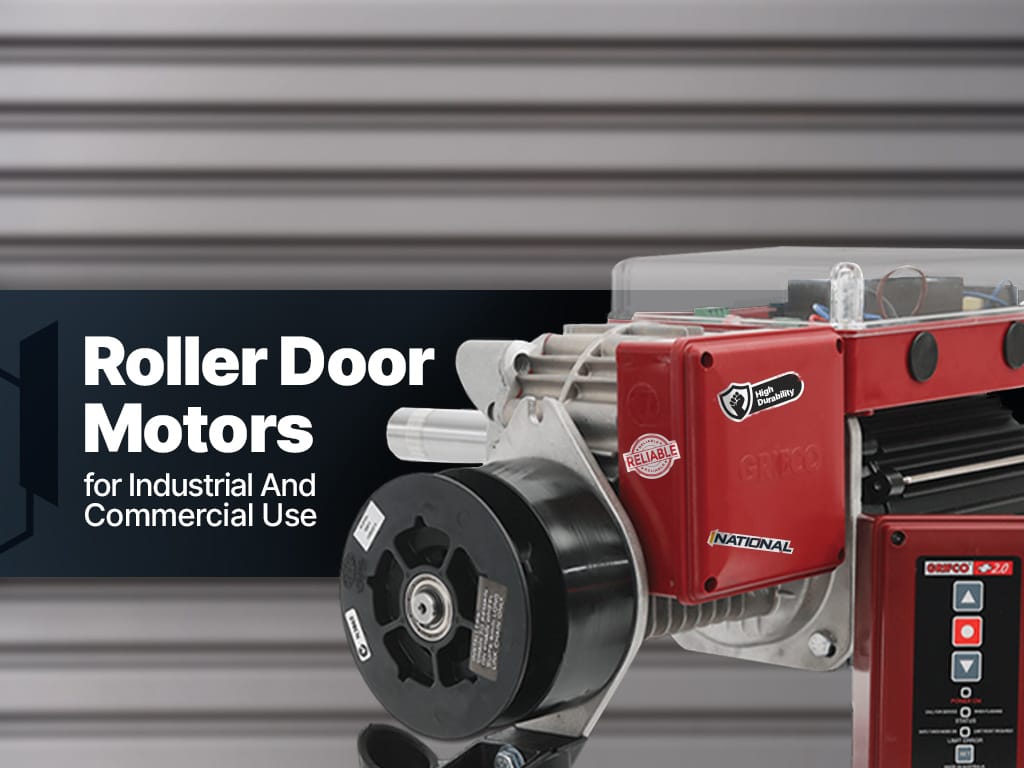
Why the Right Roller Door Motor Matters
The motor is the most critical component in any automated roller door system. Choose the wrong one and it fails ahead of schedule, creates safety risks, and generates repair costs that exceed the difference in purchase price many times over. Choose correctly and a commercial roller door motor runs reliably for a decade with nothing more than scheduled maintenance.
This guide covers everything facility managers, property managers, and commercial operators need to know about roller door motors in Australia — how they work, how to select the right motor for your application, the leading brands and models, warning signs that a motor is failing, and what repair versus replacement costs look like.
How Commercial Roller Door Motors Work
A commercial roller door motor sits above the door opening, attached to the barrel around which the curtain coils. The motor drives the barrel directly or through a shaft and gearbox, rotating it to wind the curtain up or pay it out as the door opens and closes.
The counterbalance spring system — torsion springs on most commercial and industrial doors — stores mechanical energy as the curtain lowers, releasing it to assist the motor in lifting the curtain on opening. This means the motor only needs to provide movement force rather than lifting the full curtain weight against gravity. When the spring system is correctly balanced, the motor runs well within its rated capacity. When springs are worn or incorrectly specified, the motor carries part of the curtain weight on every cycle — the single most common cause of premature motor failure on commercial roller doors.
The complete automation system: motor and gearbox, control board, limit switches (which tell the motor where to stop), safety devices (photocell beams and safety edges), and the access control trigger (remote control, loop detector, push button, or integrated access system).

Selecting the Right Roller Door Motor: Key Criteria
Door Weight and Size
Every motor has a maximum rated door weight and area. Exceeding the rating overloads the motor on every cycle. Commercial and industrial roller doors vary significantly in curtain weight depending on slat profile, door height and width, and whether the door is insulated. Get the door specifications, don’t estimate.
Daily Cycle Volume
Motors are rated for a specific number of cycles per day or per hour. A motor rated for 50 cycles per day running 150 cycles per day on a busy loading dock will reach end of life in a fraction of its rated service life. Count actual vehicle movements across a representative shift before specifying. For high-cycle applications, always specify a motor rated for at least twice your expected daily cycle volume, motors running within their rated limits run cooler, wear slower, and last longer.
Duty Cycle Rating
Duty cycle describes the percentage of time the motor can run continuously before requiring a cooling period. Light commercial motors typically have duty cycles of 25–40%. Heavy commercial and industrial motors run at 60–100% duty cycle. For continuous-use or near-continuous-use doors, loading dock doors on a busy distribution site, for example, a continuous-duty motor is the only appropriate specification.
Voltage and Power Supply
Most commercial roller door motors operate on single-phase 240V supply. Very large industrial operators require three-phase 415V supply. Confirm what’s available at the installation point before specifying, retrofitting a three-phase supply to an existing installation adds significant cost.
Environmental Conditions
Perth’s coastal salt air corrodes motor housings and electrical connections faster than inland installations. Queensland’s sustained heat pushes motors toward the top of their operating temperature range on summer afternoons. Melbourne’s winter cold affects lubricant viscosity and battery backup capacity. The motor enclosure rating (IP rating), housing material, and lubricant specification should all reflect the actual installation environment, not a generic default.
Battery Backup
For any roller door where continuity of operation during a power outage is operationally critical, battery backup is not optional. Loading dock doors, cold storage doors, and security roller shutters in commercial buildings should all be specified with battery backup as standard.
| Use Case / Need | Recommended Motor / Brand | Why It Fits |
|---|---|---|
| Heavy-duty industrial roller doors / sectional doors (factories, warehouses, loading docks) | DEA LATO or FAAC 540/541 | Both have strong gearmotors, safety encoders, manual override — ideal for heavy doors and frequent use. |
| Large commercial warehouse or medium industrial roller doors | Grifco EHD or Grifco S-Drive | Heavy-duty capacity (EHD) and smooth, reliable operation suited for regular industrial/commercial use. |
| Mid-size commercial units / multi-tenant industrial parks / smaller warehouses | Grifco LR-Drive | Compact, economical, handles moderate door sizes — suitable for lower-to-mid duty roller doors. |
| Sectional or folding industrial doors with heavy use and variety in door type | FAAC 540/541 | Versatile support for sectional, folding, overhead configurations with robust motor options. |
| Sites requiring safety, manual override and compliance (power outages, safety regulations) | DEA LATO or FAAC industrial gearmotors | Encoder-based safety management and manual release mechanisms give reliability in outage or emergency scenarios. |

Commercial and Industrial Roller Door Motor Brands in Australia
Investing in professional roller door repair brings significant advantages for businesses:
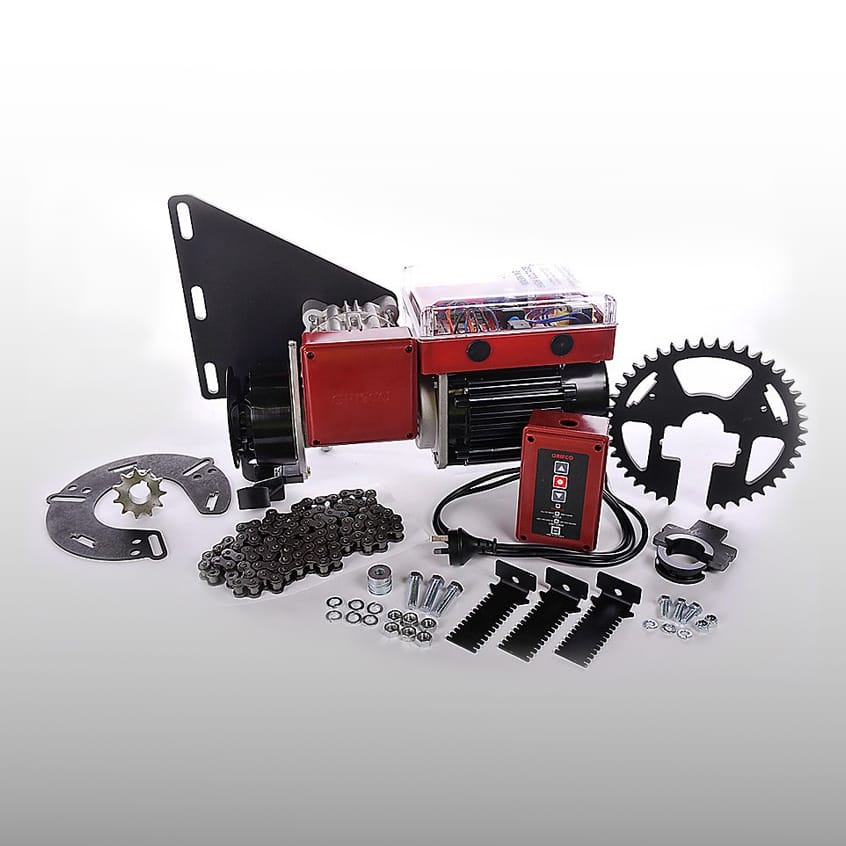
Grifco is Australia’s most widely installed commercial roller door motor brand and has been manufactured locally for decades. The Grifco range covers the full spectrum of commercial and industrial applications, with strong parts availability through the national distribution network.
Grifco LR-Drive: the benchmark commercial roller door operator for medium-duty applications. Handles roller doors up to 28m² (22m² with wind-lock). Compact profile, only 45mm side clearance required, makes it suitable for constrained installations. DC motor with soft start and stop reduces mechanical stress on the curtain and hardware. Battery backup standard. The most commonly installed commercial roller door motor across Australian warehousing, storage, and light industrial applications.
Grifco EHD (Extra Heavy Duty): for large and very large roller shutters on industrial facilities. High-torque AC motor with robust gearbox suited to the sustained loads of large industrial curtains. Designed for the daily demands of active warehouse and factory doors.
Grifco S-Drive: purpose-built for high-cycle commercial sectional doors. DC motor with fast-cycle capability, smooth operation, and a durable rail and trolley system designed for the repetition of a car park or commercial tenancy entry. Not typically used for curtain roller doors but included here for completeness given frequent buyer confusion between sectional and curtain roller door operators.
FAAC is an Italian manufacturer with a significant Australian commercial presence, particularly in industrial and high-duty applications. FAAC’s industrial gearmotors are specified where door weight, frequency of use, or the requirement for three-phase supply exceeds the practical range of Australian commercial operators.
FAAC 540/541 Gearmotors: heavy-duty industrial gearmotors for large sectional and industrial roller doors. Available in 230V and 400V configurations. Designed for intensive work cycles typical of heavy industrial environments. Appropriate for very large industrial roller doors and sectional doors on factory and distribution facilities.

ATA is an Australian company with a strong commercial roller door motor range that is widely installed across commercial and light industrial sites nationally. ATA’s commercial operators are known for robust construction, straightforward commissioning, and good parts availability through the Australian commercial door trade.
ATA Avanti Commercial Series: DC motor operators for commercial roller doors. Strong in the light to medium commercial range. Compact installation profile and reliable control board make them a common specification for commercial tenancy and warehouse roller door installations across Australia.
B&D is Australia’s largest garage door manufacturer and their commercial operator range is extensively installed across Australian commercial buildings. B&D commercial operators are particularly common in strata and commercial property stock installed over the last 15–20 years.
B&D Commercial Operators: cover the medium commercial range. Well-regarded for reliability in strata and commercial building applications. Parts availability is strong nationally given B&D’s market penetration.
GfA is a German manufacturer producing industrial roller door drives that are widely installed across Australian industrial facilities, particularly in food processing, cold chain, and high-cycle manufacturing environments. GfA drives are known for their robust construction and long service life in demanding industrial applications.
GfA Industrial Roller Door Drives: belt-driven or direct-drive industrial operators for large and heavy roller shutters. Particularly strong in food processing environments where hygiene and cleanability requirements affect motor housing and mounting specification. Three-phase supply typically required for larger GfA units.
Warning Signs Your Roller Door Motor Is Failing
Most motor failures in commercial roller doors are preceded by warning signs that appear weeks or months before the motor stops completely. Identifying these early and scheduling a service visit avoids the cost and operational disruption of a complete breakdown.
The Door Has Become Slower
A door that used to open in 8 seconds now takes 12. Gradual slowing, rather than a sudden change, indicates either increasing mechanical resistance (worn rollers or dirty track adding friction, spring tension loss making the door heavier) or motor wear reducing output torque. Either cause is addressable at the maintenance stage and becomes significantly more expensive if left until the motor fails completely.
The Motor Sounds Different Under Load
An increase in operating noise, grinding, rumbling, or a higher-pitched whine under load, indicates wear in the gearbox or motor bearings. The gearbox is often repairable if caught early. If the bearing wear progresses to the point where metal-on-metal contact occurs, the gearbox housing is typically damaged and the motor requires replacement rather than repair.
The Door Stops Mid-Cycle in Warm Weather
A door that stops mid-cycle on warm afternoons and resumes operation after cooling is experiencing thermal cutout activation, the motor’s internal thermal protection shutting it down before it overheats. This is almost always an installation problem (inadequate ventilation around the motor, direct sun exposure) or a duty cycle problem (the motor is being asked to cycle more frequently than its rated capacity allows). It is not a normal operating condition and will progressively shorten the motor’s service life if not addressed.
The Motor Hums Without Operating
A motor that hums when commanded but doesn’t turn has almost certainly suffered a capacitor failure. The capacitor provides the starting torque that gets the motor turning from rest, without it, the motor receives power but can’t start rotation. Capacitor failure is one of the most common and least expensive motor faults to repair. It is frequently misdiagnosed as motor failure, leading to unnecessary full motor replacements. Always diagnose before replacing.
Increased Frequency of Limit and Safety Faults
A motor whose control board is generating increasing frequency of limit errors, safety sensor faults, or erratic behaviour, responding inconsistently to the same commands, is showing signs of control board degradation. UV exposure, heat cycling, and moisture ingress in outdoor control board enclosures all degrade board components over time. Control board replacement is a fraction of the cost of motor replacement if addressed while the motor itself is still serviceable.
Roller Door Motor Repair vs Replacement
The decision to repair or replace a roller door motor depends on the age of the motor, the nature of the fault, the availability of parts for that brand and model, and the broader condition of the door’s mechanical system.
Repair is almost always appropriate when:
- The motor is under 8 years old and a single component has failed (capacitor, control board, limit switch)
- The fault is clearly isolated to one component with the rest of the motor in good condition
- Parts are readily available for the brand and model
Replacement is the better option when:
- The motor is 12+ years old and experiencing multiple simultaneous faults
- The motor has failed repeatedly in the last 2–3 years despite repairs
- The motor brand has been discontinued and parts are no longer available
- The motor was originally undersized for the application, replacing like-for-like repeats the same problem
The most important replacement consideration: always upsize the replacement motor to the correct specification for the door’s actual weight and daily cycle volume. A motor that is replaced like-for-like when the original was undersized for the application will fail at the same rate as the original. We measure and specify correctly before any replacement.
Frequently Asked Questions
My roller door motor is tripping on hot days, is the motor failing? Not necessarily. A motor that stops mid-cycle on hot afternoons and recovers after cooling is hitting its thermal limit, the motor’s internal protection switching it off before it overheats. This is usually an installation issue (inadequate ventilation around the motor housing, or direct afternoon sun exposure) or a duty cycle issue (the motor is cycling more frequently than its rated capacity). It’s a warning sign worth investigating, but not evidence of imminent motor failure.
Can I replace a roller door motor myself? Replacing a commercial roller door motor involves working with 240V mains supply, handling a counterbalance spring system that stores significant mechanical energy, and configuring the replacement motor’s limit switches and control board for the specific door. It requires a licensed electrician for the electrical work and should be carried out by a technician experienced with commercial roller door systems. It is not a DIY task.
What is the most reliable roller door motor brand in Australia? Grifco and ATA are the most widely installed commercial roller door motor brands in Australia, with the strongest parts availability and the broadest service network. Both brands have proven track records across the full range of Australian commercial applications. For heavy industrial applications — very large curtains, three-phase supply, continuous-duty requirements, FAAC and GfA are appropriate specifications. The right brand depends on the application, not a blanket preference.
How long should a commercial roller door motor last? A correctly specified and regularly maintained commercial roller door motor should last 10–15 years in a standard commercial application. High-cycle industrial applications may see motor replacement at 7–10 years. Motors that were undersized from installation or that have operated without maintenance typically fail well before these benchmarks.
Do you carry parts for all roller door motor brands? We carry common parts for Grifco, ATA, BnD, FAAC, and GfA, the brands that make up the majority of Australia’s installed commercial roller door motor stock. For less common brands, we confirm parts availability before confirming any repair timeline.