
Automatic Doors Australia
Supply, Installation & Service
Automatic doors are one of the highest-traffic components in any commercial or public building, opening and closing hundreds or thousands of times each day, carrying legal obligations under Australian Standards, and creating the first and last impression every visitor has of your facility. When they work well, nobody notices. When they don't, everyone does.
National Entrance Systems supplies, installs, and maintains commercial and industrial automatic door systems across Australia. We cover the full range, automatic sliding doors, swing doors, telescopic doors, and revolving doors, for retail centres, hospitals, commercial offices, healthcare facilities, industrial sites, and institutional buildings. All installations comply with AS 5007, the Australian Standard governing powered doors for pedestrian access and egress.
24/7
- Same-Day & Emergency Repairs
- Industrial & Commercial Sites
- All Major Brands Serviced
- Transparent Pricing
Types of Automatic Doors
We Install, Repair, and Maintain
Automatic Sliding Doors
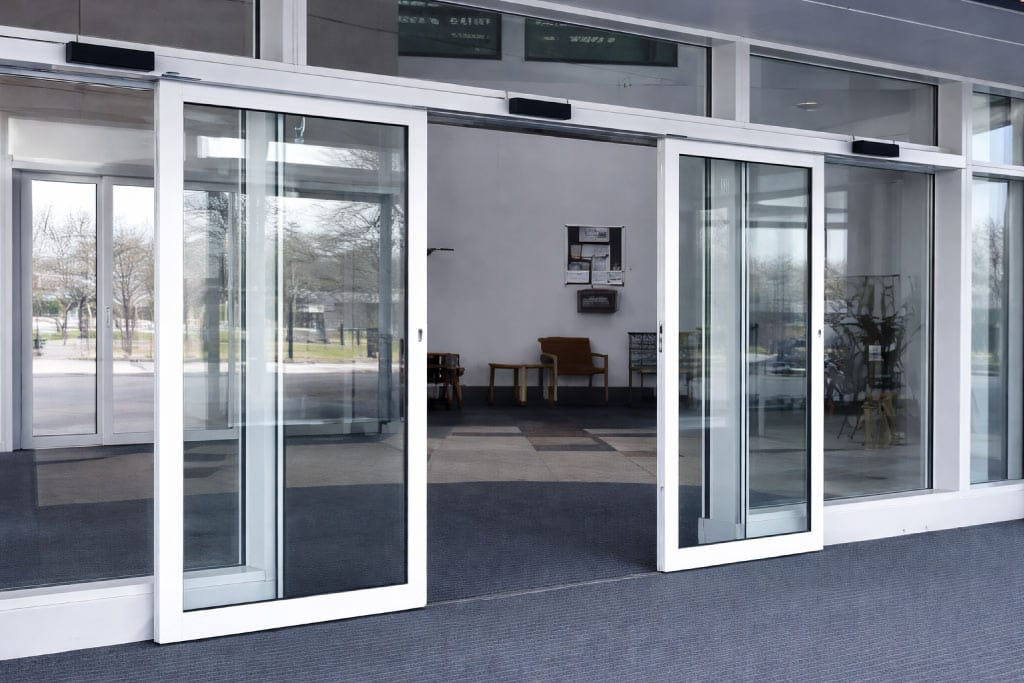
The most widely installed automatic door type in Australian commercial buildings. Two door panels — or a single panel in a single-slide configuration — slide horizontally on a track system driven by an overhead operator unit. Sensor arrays above the door detect approaching pedestrians and trigger the opening sequence.
Single-slide: One panel slides to one side. Suited to narrower openings or where space is available on only one side.
Bi-part (centre-opening): Two panels open from the centre, each travelling to opposite sides. The most common configuration for retail, hospital, and commercial lobby entrances — creates a wide, symmetrical opening and the most welcoming entry presentation.
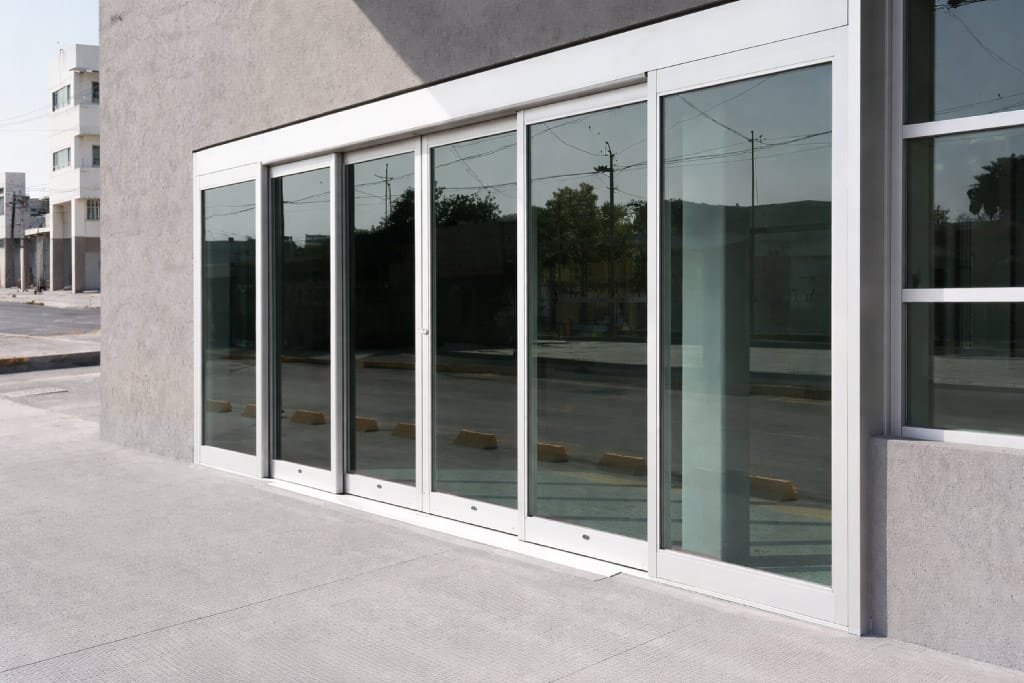
Telescopic: Multiple narrow panels that slide and stack, providing a wider clear opening from a narrower wall recess. Used where the standard bi-part configuration would require more wall space than is available.
Best for: Retail centres, supermarkets, hospitals, medical centres, commercial office lobbies, hotels, aged care facilities, transport terminals, and any high-pedestrian-traffic entrance requiring hands-free, accessible operation.
Automatic Swing Doors
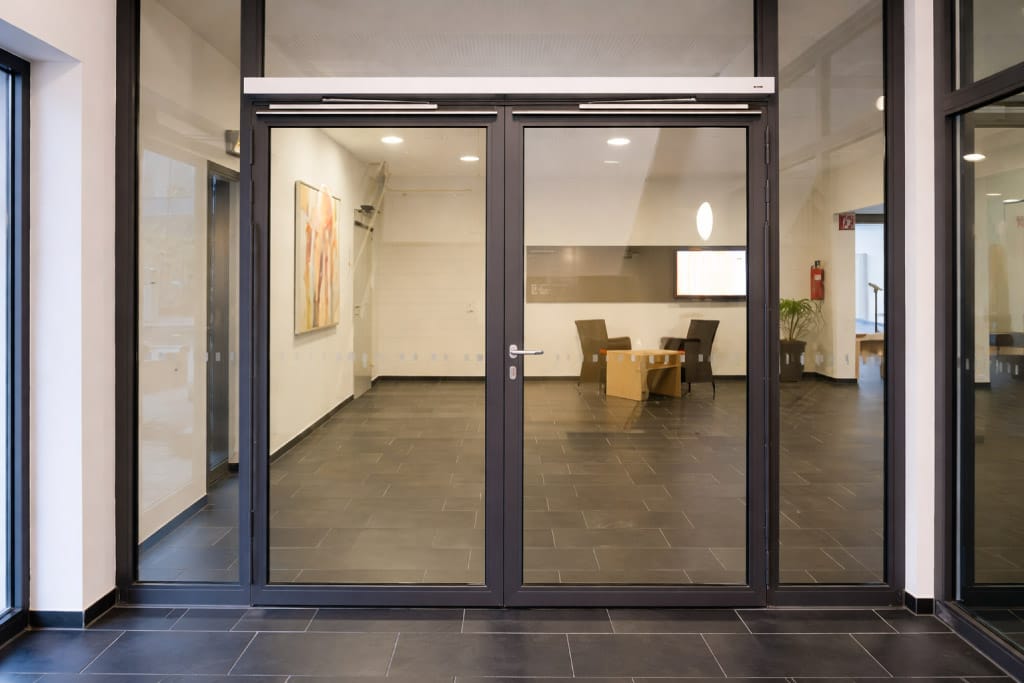
A single or double door panel that swings open on a powered overhead operator when triggered by a sensor or push-button activation. Often specified where the building architecture already incorporates a traditional door frame and a sliding track system would require structural alteration, or where the door needs to remain closed as a default (for thermal or acoustic separation) and only open when activated.
Low-energy swing operators: Open slowly and gently, ideal for accessibility applications, aged care, medical facilities, and any environment where vulnerable users are present. Meets DDA (Disability Discrimination Act) requirements for accessible entry.
Full-power swing operators: Faster operation for higher-traffic applications. Often used in hospital corridors, commercial loading areas, and industrial environments where hands-free operation is required but swing door geometry is preferred.
Best for: Aged care facilities, medical clinics, hospitals, commercial offices with existing swing door frames, accessible entries, and any application where a swing configuration is architecturally required.
Revolving Doors
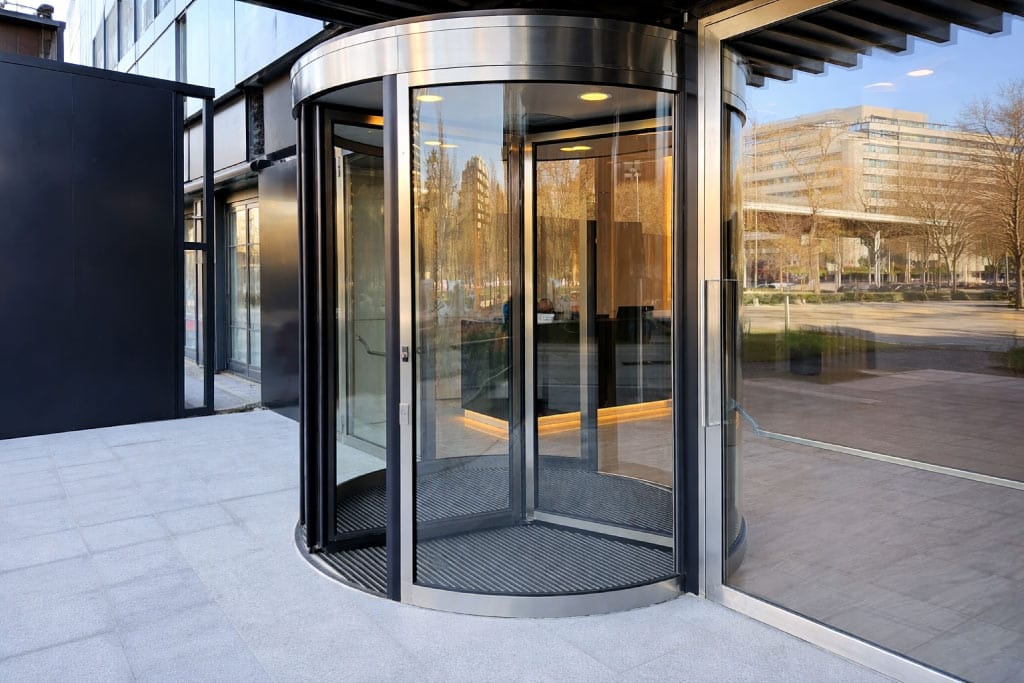
Three or four door panels rotating around a central axis within a circular enclosure. Revolving doors create a near-continuous air seal between internal and external environments, significantly reducing heating, cooling, and ventilation load in buildings with high pedestrian throughput.
Why revolving doors matter for energy costs: In a standard automatic sliding door, every opening cycle creates an air exchange between inside and outside. In a large retail or commercial building with hundreds of opening cycles per hour, this represents a substantial ongoing energy cost. A revolving door virtually eliminates this exchange — the door always has at least one panel creating a seal.
Best for: Large commercial buildings, hotels, corporate headquarters, airports, hospitals, and any high-traffic facility where energy efficiency and climate separation are priorities.
Telescopic Sliding Doors
A multi-panel system where panels slide and overlap (telescope) as the door opens, creating a wider clear opening from a smaller wall footprint than a standard sliding system. Critical in environments where maximising the clear opening width for accessibility or equipment movement is essential, but available wall space is constrained.
Best for: Hospital corridors and wards where wide openings are required for beds and equipment, retail centres with limited front wall depth, and any site requiring maximum clear width from minimum recess space.
AS 5007 Compliance: What Facility Managers Need to Know
Australian Standard AS 5007-2007 (Powered doors for pedestrian access and egress) governs the design, installation, and ongoing maintenance of automatic pedestrian doors in Australia. This is a mandatory standard — not a guideline — and has direct implications for both installation specifications and ongoing maintenance obligations.
- Installation: Sensors must cover the full opening zone and approach area to prevent contact with pedestrians. Opening and closing forces are limited to protect against injury. Fail-safe mechanisms must allow manual operation in a power outage.
- Maintenance frequency: AS 5007 Appendix E requires that powered automatic doors be regularly serviced to ensure correct and safe working order. The industry standard interpretation is quarterly (every three to four months) for high-traffic commercial and public access doors. Lower-traffic applications may extend to six-monthly intervals.
- Documentation: Service records must be maintained and available for inspection. This is particularly important for facility managers in healthcare, retail, and institutional settings where safety compliance audits occur.
We provide AS 5007-compliant installations and structured maintenance programs with written condition reports after every service visit, giving facility managers the documentation trail their compliance obligations require.

Automatic Door Repair
Automatic doors in commercial and public buildings fail in predictable ways. Knowing the likely cause helps you respond faster and communicate clearly with a technician.
We service and repair all major automatic door brands operating in Australia: ASSA ABLOY, dormakaba, RECORD, Besam, Tormax, FAAC, Auto Ingress, Gilgen, GEZE, and others. We attend sites regardless of who originally installed the system
Door won’t open: Sensor failure or misalignment is the most common cause, the door doesn’t know anyone is there. Also check for power supply faults and control board errors.
Door won’t close: Often a safety sensor fault, the system thinks an obstruction is present when it isn’t. Can also indicate a control board issue or a door that has been manually held open and left in an override state.
Door opens and closes erratically: Usually sensor misalignment, particularly common after nearby fit-out work, cleaning, or any activity that disturbs the sensor positioning. External interference from reflective surfaces or HVAC airflow can also trigger false detections.
Door opens and closes erratically: Usually sensor misalignment, particularly common after nearby fit-out work, cleaning, or any activity that disturbs the sensor positioning. External interference from reflective surfaces or HVAC airflow can also trigger false detections.
Door moves slowly or sluggishly: Motor wear, belt or drive chain degradation, or door panel misalignment causing drag. Often a sign that a service is overdue.
Door has stopped mid-cycle and won’t move: Safety system activation — the door has detected or registered an obstruction (real or false) and locked out. Check for visible obstructions first. If clear, a reset via the control panel may restore operation; if not, a technician visit is required.
commercial and institutional facilities across Brisbane and South East Queensland
commercial properties and healthcare facilities across the Perth metro area
Automatic Door Adelaide and Regional
commercial and industrial coverage across SA and key regional locations nationally
Automatic Door Repair & Installation Across Australia
Our installation and service teams are locally based across Australia, not dispatched from a central hub. This means realistic response times and no inflated travel costs for regional sites.

retail centres, hospitals, commercial offices, and industrial facilities across Greater Sydney
commercial buildings, healthcare facilities, and institutional sites across the Melbourne metro
government buildings, university facilities, and institutional sites across the ACT
Why Choose National
For Your Automatic Doors
When every minute of downtime costs you productivity, you need a partner you can rely on. National Entrance Systems delivers consistent, professional, and safe service, every time.
We Work with the World’s Most Trusted Brands
We partner with leading manufacturers to ensure every installation, repair, and upgrade meets global quality and reliability standards.




Maintenance Programs
Under AS 5007, regular maintenance is not optional for commercial automatic doors, it is a legal requirement. A door that injures a visitor because of a failed sensor or excessive closing force creates serious liability exposure for the building owner or operator. Our structured maintenance programs for commercial automatic doors include:
- Full sensor array test: detection zones, approach coverage, and safety beam verification
- Drive system inspection: detection zones, approach coverage, and safety beam verification
- Opening and closing force measurement against AS 5007 limits
- Door panel alignment check and adjustment
- Control board diagnostic scan and error log review
- Manual release and fail-safe mechanism test
- Weather seal condition check
- Written condition report with AS 5007 compliance notation
- Roller and track cleaning and lubrication
Get a Fast Quote for Your Automatic Door Repair
Tell us about your site, the location, the application, the approximate traffic volume, and any access control requirements, and we’ll come back with a recommendation and written quote. For larger projects, we’ll arrange a free site visit first.
- 1300 044 400
- hello@nationalco.com.au
- National Entrance Systems
Frequently Asked Questions
How often do commercial automatic doors need servicing under Australian Standards?
Can you service automatic doors installed by another company?
My automatic door is slow or hesitating, do I need a repair or a service?
Do automatic doors meet accessibility requirements for DDA compliance?
What happens if the power goes out?
Explore Our Related Services
Keep your facility running smoothly with our full range of door and gate repair, maintenance, and automation services. From rapid and roller doors to boom gates and access systems, our certified technicians deliver reliable, efficient solutions that ensure safety, compliance, and continuous operation across every part of your site.