
Industrial Sectional Door Repair & Maintenance Australia
When a sectional door fails in a warehouse or distribution facility, the impact is immediate. A loading dock that can't open stops inbound freight. A dock that can't close compromises temperature control, security, and weather protection. Neither situation should require a long wait for a contractor who arrives without the right parts.
National Entrance Systems repairs and maintains industrial and commercial sectional doors across Australia. We work across all major brands and configurations, insulated and non-insulated panels, standard and high-lift track systems, manual and automated operation, and carry common parts on-van for the most frequent fault types.
24/7
- Same-Day & Emergency Repairs
- Industrial & Commercial Sites
- All Major Brands Serviced
- Transparent Pricing
Common Sectional Door Faults We Repair
Understanding what’s gone wrong before you call helps you communicate the fault clearly, and helps us bring the right parts on the first visit.
Spring System Failure
Torsion springs are the highest-risk and most consequential failure mode on any sectional door. These springs store significant mechanical energy under tension, when one fails, it does so suddenly and often audibly (the characteristic loud bang that warehouse staff recognise immediately). After a spring failure, the door becomes very heavy, the motor can no longer lift it, and the manual release, if the door is automated, may not allow safe manual operation until the broken spring is removed.
Signs a spring is nearing failure:
- The door has become noticeably heavier over time when operated manually
- The motor sounds like it’s working harder than usual, straining rather than running freely
- The door doesn’t hold position at mid-travel when stopped (drops slightly, indicating the spring is no longer balancing the panel weight)
- Visible rust, corrosion, or distortion on the spring coils
Spring replacement: Springs are matched to the door’s exact weight and height. Fitting an undersized spring means the door will always be heavy and the motor will be overloaded; fitting an oversized spring means the door will fly up and the motor will be unable to control the closing speed. We measure and specify correctly before fitting. Springs on commercial and industrial sectional doors are under far greater tension than residential springs, replacement must only be carried out by trained technicians with appropriate winding equipment.

Panel Impact Damage
Forklifts, pallet walkers, and delivery vehicles are the primary source of panel damage on loading dock sectional doors. A truck reversing with trailer doors unsecured, a forklift operator misjudging the clearance, or a vehicle contact from the outside, all produce panel damage ranging from minor dents to complete panel collapse.
Individual panel replacement: Where damage is localised to one or two panels and the hinge, roller, and track system are otherwise undamaged, individual panel replacement restores the door without full replacement. We source replacement panels from major Australian and international suppliers for all common door brands and profiles.
When full replacement is appropriate: Where impact has distorted the track system, damaged multiple panels, compromised the hinge chain, or where the affected panels are from a discontinued range with no available replacement, a full door replacement may be more practical than repair.

Guide Track Damage and Misalignment
The vertical and horizontal guide tracks keep the door’s rollers correctly positioned throughout the travel path. Track damage, from forklift contact, vehicle impact, or building movement, causes the door to bind, scrape, deviate from its correct travel path, or jam mid-travel. Even relatively minor track distortion creates significant operating problems because the rollers have very tight clearances in the track channel.
On-site track repair: Minor track distortion, kinks, slight bends, loosened mounting brackets, can often be corrected on-site without track replacement. We assess the severity of distortion and advise on whether correction or replacement is the appropriate response.
Track replacement: More significant damage, particularly to the curved radius section where the track transitions from vertical to horizontal, often requires section replacement. Radius section damage is common after forklift contact with the lower portion of the door and is one of the most disruptive repairs, the door typically cannot operate at all until the radius section is replaced.
Hinge and Roller Wear
Hinges connect adjacent door panels and allow them to articulate as the door travels through the curved track section. Rollers are the nylon or steel wheels that run inside the guide tracks, supporting the panel weight and guiding the door’s movement. Both wear over time through the friction of normal operation.
Hinge failure signs: Visible play between adjacent panels (they should move cleanly at the hinge without lateral or rotational play), squealing or grinding noise during operation specifically at the point where panels articulate, or visible cracking or distortion of hinge plates.
Roller failure signs: Grinding or rumbling noise during operation (worn roller bearings), increased resistance to manual operation, or visible flat spots or cracking on roller wheels. Worn rollers cause accelerated track wear — a roller that has degraded enough to lose its round profile creates a hammering action in the track channel that damages the track from the inside.
Maintenance approach: Hinge and roller condition is assessed at every service visit. We replace worn components before they cause failure or secondary damage.
Lift Cable Failure
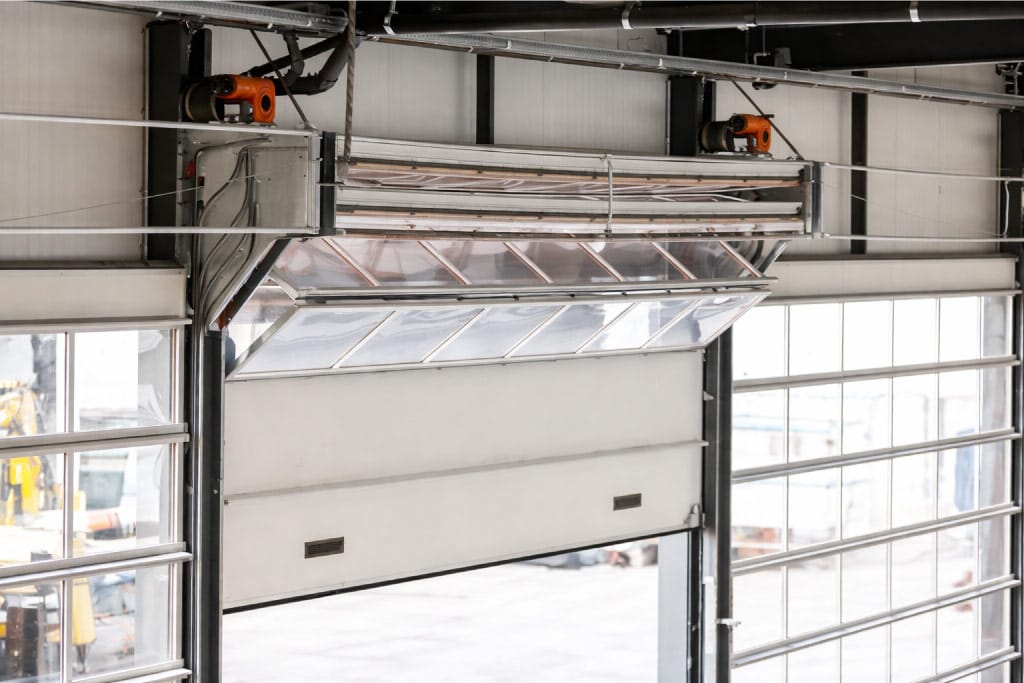
Lift cables run from the bottom bracket of the door panel up over drums on the torsion spring shaft, translating the spring’s stored energy into a lifting force on the door. Cable failure — from fraying, corrosion, or a sudden overload event — causes the door to drop suddenly on the failed side, often with significant panel and track damage as a secondary result.
Cable inspection: Cables should be inspected at every service visit for fraying, kinking, corrosion on the cable strands, and proper seating in the cable drum. A frayed cable is a pre-failure warning — replacement before the cable breaks avoids both the safety hazard of a sudden door drop and the secondary repair cost.
Cable replacement: Cable replacement is a tension-management job — the springs must be safely controlled during cable fitting. We treat cable replacement as a same-priority repair as spring replacement.

Operator and Automation Failure
- Spring balance: confirm the door is correctly counterbalanced before diagnosing the motor
- Manual release: confirm the door can be safely moved by hand, confirming the spring system is intact
- Power supply: confirm the motor is receiving power
- Control board fault log: read any stored fault codes before opening the enclosure
- Safety devices: confirm all photo beams and safety edges are operational
- Limit switches: confirm limits are set correctly for the door’s current position

Bottom Seal and Weatherseal Degradation
The bottom seal contacts the floor threshold on every closing cycle. On a high-cycle loading dock door, this translates to significant seal wear. Degraded bottom seals allow air, water, dust, insects, and pests to enter the facility — a particular concern for food processing, pharmaceutical, and cold chain facilities where environmental control is critical.
Side and top weatherseals degrade from UV exposure and physical contact. We inspect and replace all weatherseals as part of maintenance visits and on reactive callouts where environmental ingress is reported.

Maintenance Programs for Industrial Sectional Doors
The additional mechanical complexity of a sectional door, more components, more alignment requirements, more wear points, means that maintenance is proportionally more important. A roller door can run for years with minimal maintenance and degrade gradually. A sectional door with worn rollers, fraying cables, or a torsion spring nearing end-of-life can fail suddenly and spectacularly. The maintenance investment is higher, but so is the cost of the reactive repair when something fails without warning.
Panel and hinge system:
- All panels inspected for damage, distortion, dents, and corrosion
- All hinges inspected for wear, play, cracking, and correct pin retention
- Panel seals between sections: integrity and condition
- Bottom seal condition and floor contact assessment
- Side and top weatherseal condition
Spring and counterbalance system:
- Torsion spring visual inspection: coil condition, end fitting, corrosion, fatigue signs
- Spring balance check: door should remain at mid-travel without drifting
- Cable condition: both cables inspected for fraying, kinking, and proper drum seating
- Cable drum and spring shaft bearings
Guide system:
- All rollers inspected: wheel condition, bearing noise, axle wear
- Roller lubrication
- Vertical track inspection: alignment, mounting bracket torque, debris
- Horizontal ceiling track inspection: alignment, support bracket condition
Automation and safety:
- Motor performance test: current draw and operating sound
- Limit switch verification: open and close positions
- Safety edge function test
- Photocell beam alignment and function test
- Control board diagnostic scan
Metro and South East Queensland coverage including the southern and western industrial precincts (Acacia Ridge, Wacol, Yatala)
Metro and key WA regional locations; highest demand in Kewdale, Welshpool, Henderson, and Malaga industrial zones
Adelaide and Regional
Metro SA including the northern and southern industrial corridors (Wingfield, Regency Park, Lonsdale)
Hobart and Tasmania
Greater Hobart and key Tasmanian commercial locations
Where We Repair and Service Sectional Doors
Our technicians are locally based across Australia, covering all major commercial and industrial markets:

All metro suburbs; highest demand in Western Sydney (Wetherill Park, Smithfield, Eastern Creek), South Sydney (Alexandria, Botany), and the South West logistics corridor (Liverpool, Prestons, Moorebank)
Full metro coverage; high demand in the western and south-eastern industrial corridors (Dandenong, Truganina, Laverton, Campbellfield)
Full ACT coverage including Fyshwick, Mitchell, Hume, and Beard industrial zones
Darwin metro with cyclone-rated service standards for all NT work
Why Choose National
For Sectional Door Repairs
We combine technical expertise with exceptional service, ensuring every repair and maintenance job is completed safely, efficiently, and to the highest standard.
We Work with the World’s Most Trusted Brands
We partner with leading manufacturers to ensure every installation, repair, and upgrade meets global quality and reliability standards.




How Industrial Sectional Doors Work
Understanding the basic mechanics helps identify faults faster and communicate more clearly when logging a callout.

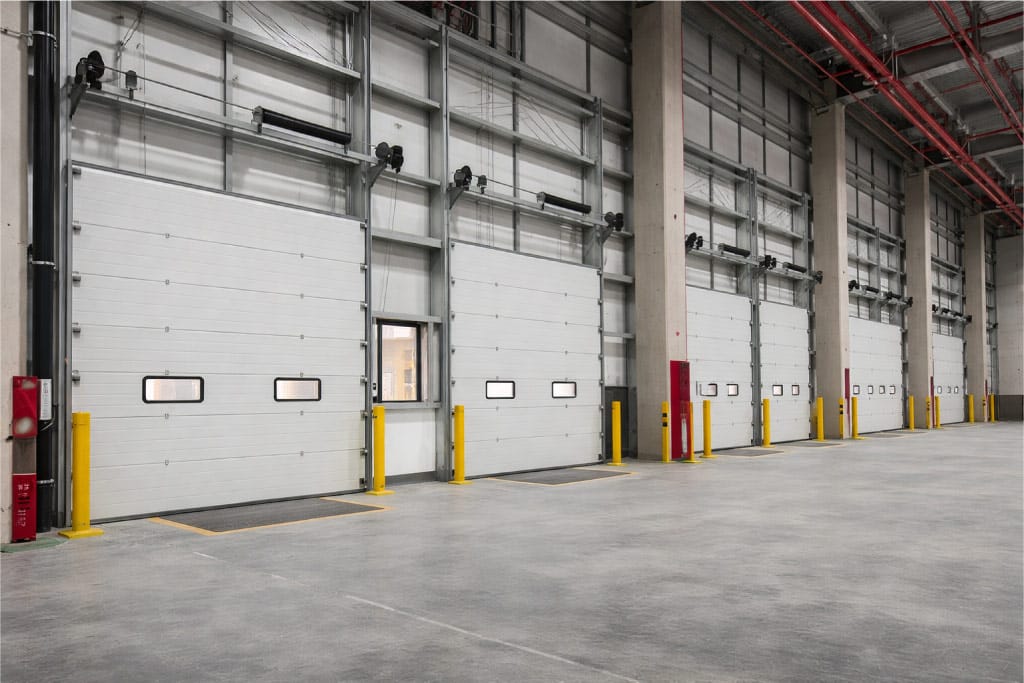
A sectional door consists of four to eight horizontal steel panels connected by hinges. Each panel travels upward along vertical guide tracks mounted to the wall on either side of the opening, passing through a curved radius section before folding horizontal along ceiling-mounted tracks parallel to the floor. The counterbalance spring system — almost always torsion springs on commercial and industrial doors — stores the energy needed to lift the panel weight, so the motor or manual operator only needs to provide the movement force rather than lift the door against gravity.
Get a Fast Quote for Your Sectional Door Repair
Tell us about your site, the location, the application, the approximate traffic volume, and any access control requirements, and we’ll come back with a recommendation and written quote. For larger projects, we’ll arrange a free site visit first.
- 1300 044 400
- hello@nationalco.com.au
- National Entrance Systems
Frequently Asked Questions
What is the difference between a sectional door and a roller door?
My sectional door is very heavy — is that a spring problem?
Can you repair individual panels or does the whole door need replacing?
How long do torsion springs last on a commercial sectional door?
Do you carry out emergency sectional door repairs?
Real Results,
Reliable Performance


Explore Our Related Services
Keep your facility running smoothly with our full range of door and gate repair, maintenance, and automation services. From rapid and roller doors to boom gates and access systems, our certified technicians deliver reliable, efficient solutions that ensure safety, compliance, and continuous operation across every part of your site.