
Rapid Doors Australia
High-Speed Industrial Door Supply, Installation & Service
National Entrance Systems supplies, installs, and maintains rapid door systems across Australia for warehouses, cold storage facilities, food processing plants, pharmaceutical manufacturers, cleanrooms, and logistics operations. We work with all major types and brands, and service existing systems regardless of who installed them.
In a warehouse where forklifts pass through an internal doorway three hundred times a shift, a standard roller door cycling at 0.2 metres per second creates a three-to-five second wait every single time it opens. Across an eight-hour shift, that’s fifteen to twenty-five minutes of accumulated wait time, per doorway, per shift, every day. A rapid door cycling at 1.5 metres per second reduces that to under a second. The productivity case writes itself.
But throughput speed is only part of why rapid doors are specified. In cold storage, food processing, pharmaceutical manufacturing, and cleanroom environments, every second the door is open is a second of thermal transfer, contamination risk, or pressure differential disruption. Rapid doors don’t just move fast, they minimise the window during which controlled environments are exposed to uncontrolled conditions.
24/7
- Same-Day & Emergency Repairs
- Industrial & Commercial Sites
- All Major Brands Serviced
- Transparent Pricing
Types of Rapid Doors We Supply
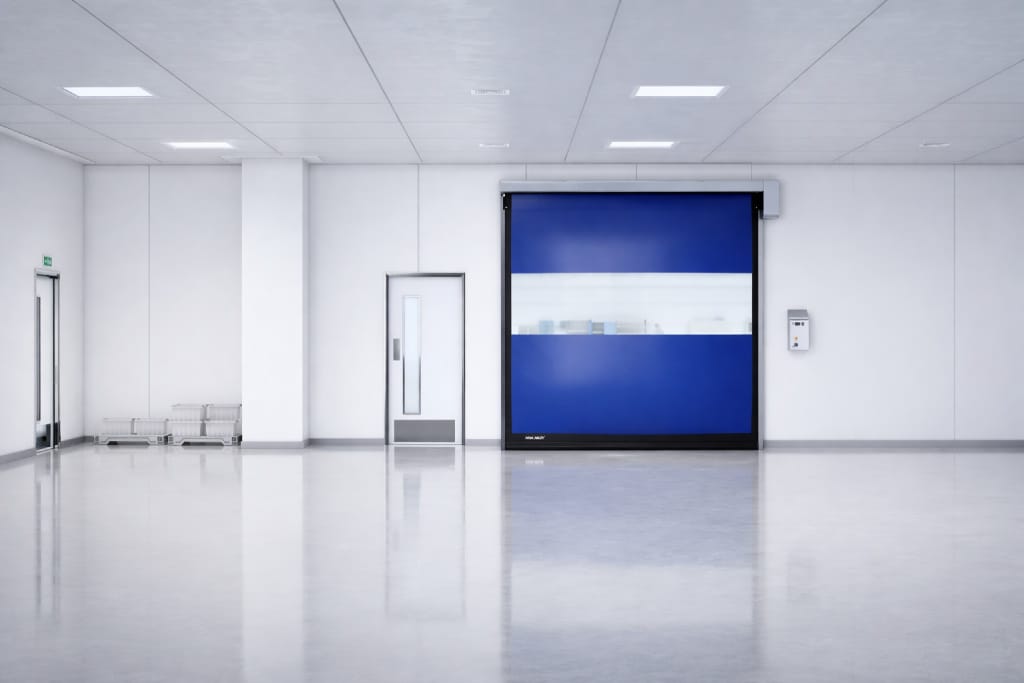
Standard High-Speed PVC Fabric Doors
The most widely installed rapid door type in Australian industrial and logistics facilities. A flexible PVC-coated polyester curtain rolls and unrolls from a drum above the opening at speeds typically between 0.8 and 1.5 metres per second, significantly faster than a standard roller door. The fabric curtain is lightweight, meaning minimal motor load and low energy consumption per cycle.
Self-repairing design: Most modern fabric rapid doors are designed to “crash out” on vehicle impact rather than resist. If a forklift strikes the curtain, the fabric releases from its side guides cleanly, then re-inserts automatically as the door cycles back up, eliminating repair downtime. This feature alone justifies the premium over standard roller doors in high-forklift-traffic environments.
Activation options: Radar (vehicle detection without ground loops), inductive floor loops, push-button, remote control, photoelectric beams, and motion detection. Most installations use radar or loop detection for fully hands-free operation.
Best for: Internal warehouse access points, production area separations, dock approaches, and any high-cycle internal doorway in a logistics, manufacturing, or distribution facility.
Standard sizes: Up to 4,500mm wide × 6,000mm high. Custom sizes available.
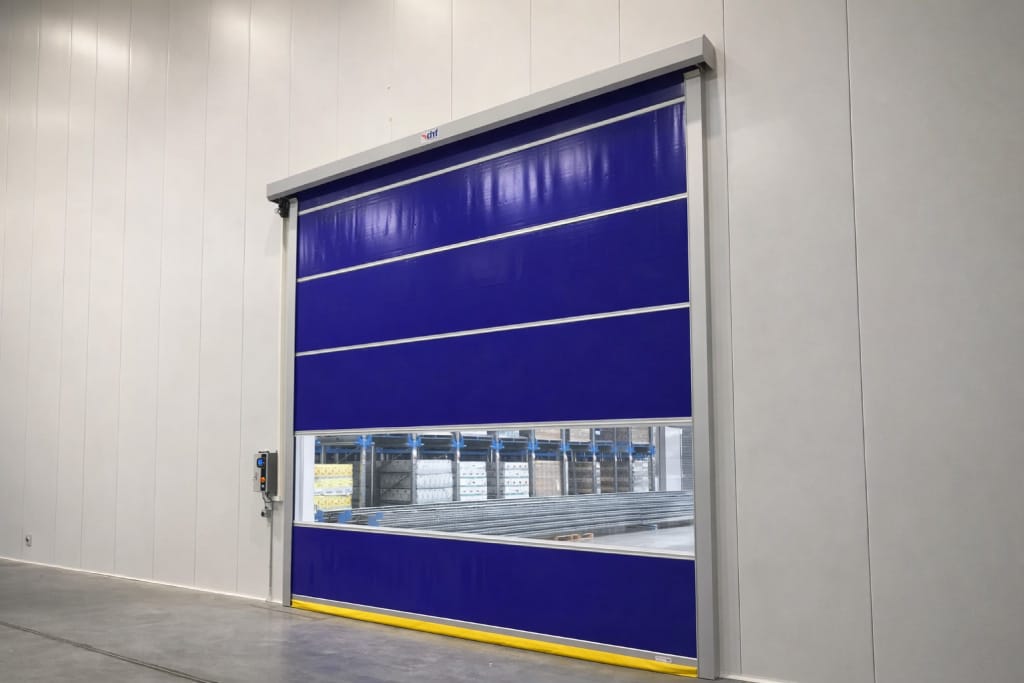
Cold Room and Freezer Rapid Doors
Insulated fabric rapid doors engineered specifically for temperature-controlled environments. The curtain incorporates foam insulation between PVC layers, single-layer foam for cool rooms, double-layer foam for freezer applications, significantly reducing thermal transfer per cycle compared to a standard fabric door.
Frames and motor housings in cold storage applications are typically anodised aluminium or stainless steel to resist corrosion from condensation and wash-down chemicals. Seals are designed to maintain an airtight closure that preserves the temperature differential between controlled and ambient environments.
Why speed matters in cold storage: A standard roller door takes 10–15 seconds to open fully. During those 15 seconds, warm humid air enters the cold zone, condensing on product and racking and loading the refrigeration system. A rapid door cycling in under two seconds dramatically reduces this infiltration, cutting refrigeration energy costs and improving product shelf life.
Best for: Cool rooms, cold stores, blast freezer entries, refrigerated logistics facilities, supermarket distribution centres, and food processing environments requiring temperature separation.
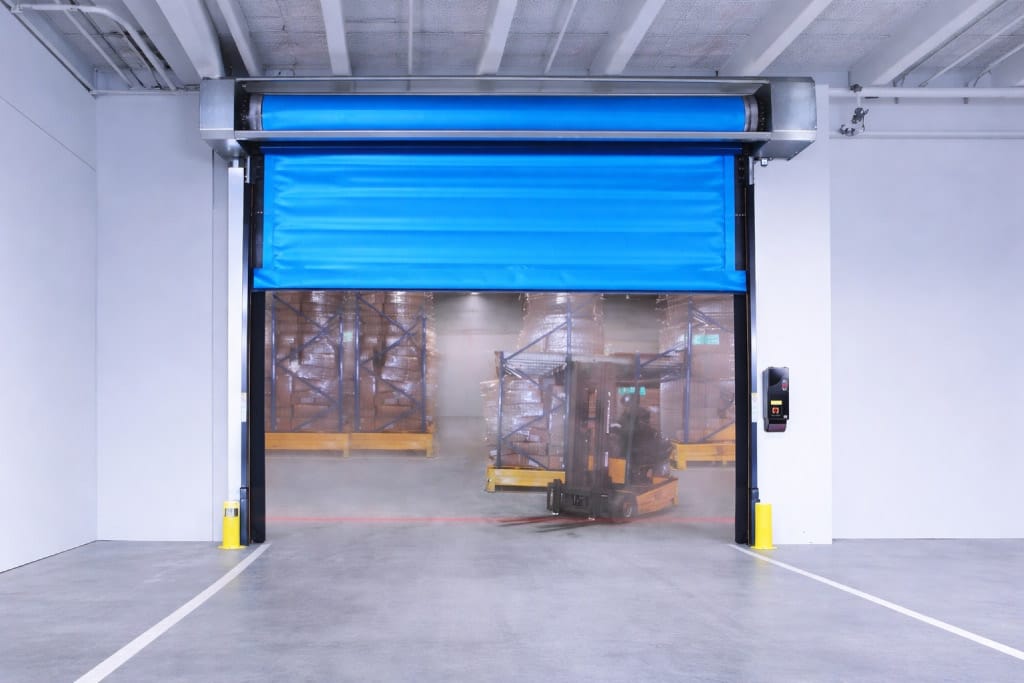
Cleanroom and Pharmaceutical Rapid Doors
High-specification fabric doors designed for controlled environments, pharmaceutical manufacturing, hospital sterile areas, food production with strict hygiene requirements, and ISO-rated cleanrooms. These doors combine rapid cycle speed with airtight sealing, pressure differential capability, and surfaces engineered for wash-down and contamination control.
Key specifications for cleanroom applications include:
- Stainless steel frames and motor housings for chemical resistance and wipe-down compatibility
- Fabric curtains with no exposed horizontal surfaces that collect contamination
- Air leakage rates specified to maintain pressure differentials between zones
- Interlocking capability, preventing both doors of an airlock from opening simultaneously
Best for: Pharmaceutical manufacturing, sterile processing areas, food production facilities with GMP requirements, hospital clean areas, and any ISO-rated cleanroom environment.
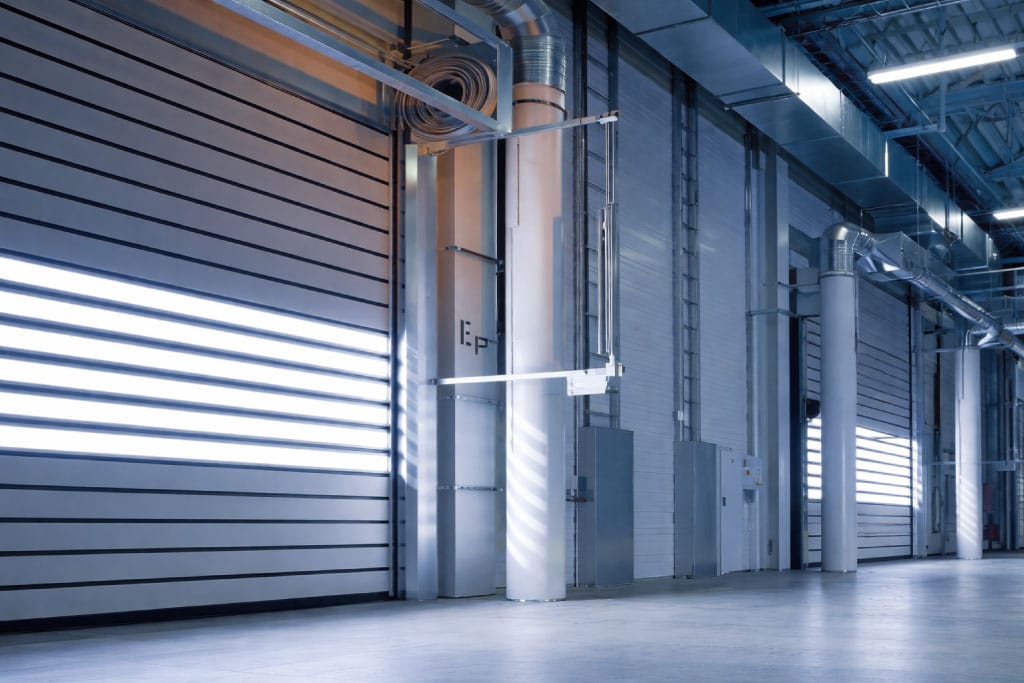
High-Speed Spiral (Aluminium Slat) Doors
Instead of a flexible fabric curtain, spiral doors use rigid aluminium slats that wind into a compact spiral housing above the opening, eliminating the overhead barrel space required by fabric roll-up systems. Operating speeds of up to 2.0–2.5 metres per second, with very low air infiltration due to the rigid panel construction.
Spiral doors are significantly more expensive than fabric rapid doors but offer superior security (the rigid aluminium panel can’t be breached like fabric), longer service life, and the ability to function as both a high-speed internal rapid door and an after-hours security barrier, eliminating the need for a separate security shutter.
Best for: High-security applications requiring both rapid access during operation and security barrier function after hours, external applications with high wind loads, facilities where overhead barrel space is constrained, and sites requiring very high cycle longevity.
Folding Rapid Doors
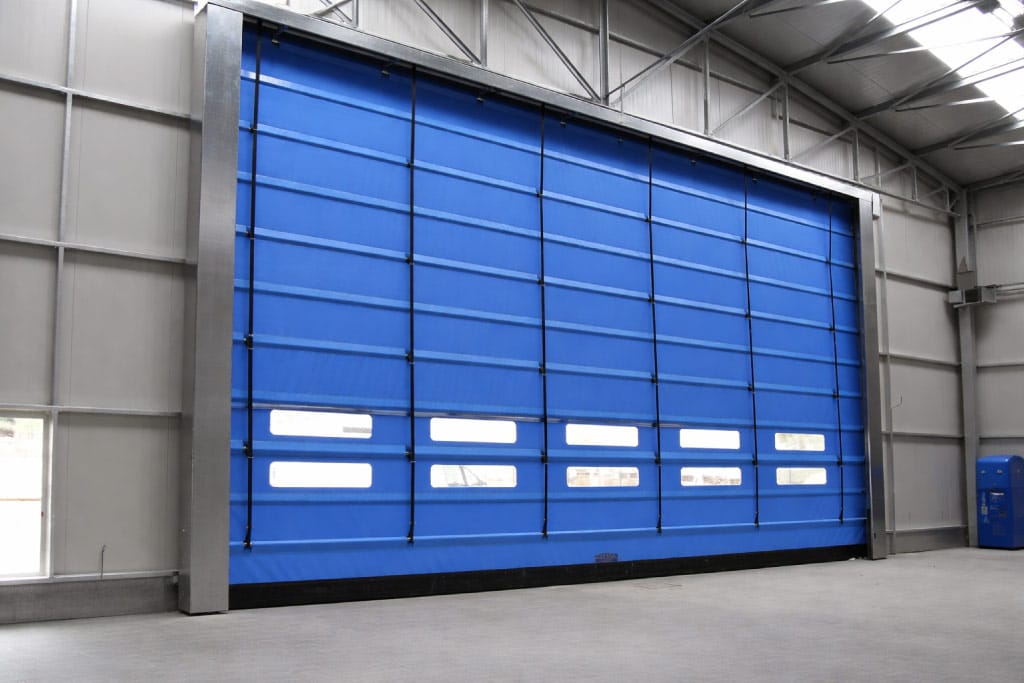
For sites with high wind loads where a standard fabric roll-up door would be vulnerable to wind pressure, folding rapid doors use rigid or semi-rigid panels that fold concertina-style into the door head rather than rolling. The folded panel provides better wind resistance than a hanging fabric curtain.
Best for: External dock entries exposed to prevailing wind, loading bay approaches in exposed coastal or industrial locations, and any external rapid door position with regular high wind loading.
Key Specifications to Understand Before Buying
Rapid doors are specified by facilities teams and project managers who often haven’t bought them before. These are the variables that actually matter:
- Opening speed: Measured in metres per second (m/s). Standard fabric rapid doors open at 0.8–1.5 m/s. High-performance spiral doors reach 2.0–2.5 m/s. Higher speed costs more but delivers more productivity benefit and greater thermal efficiency per cycle.
- Closing speed: Usually slower than opening speed (0.5–1.0 m/s) for safety. The door shouldn't descend faster than people or vehicles can safely clear it.
- Door dimensions: Rapid doors are built to measure. Maximum standard sizes vary by manufacturer — most fabric doors go to 4,500mm wide × 6,000mm high; larger openings require custom engineering or dual-door configurations.
- Duty cycle: The number of cycles per hour the door is rated for. High-cycle warehouse applications need doors rated for continuous operation, 500+ cycles per hour. Undersizing the duty cycle rating leads to premature motor and curtain wear.
- Curtain material: Standard PVC fabric for general warehouse use; insulated PVC for temperature-controlled environments; stainless steel-compatible fabric and frame for washdown/cleanroom applications. Specifying the wrong curtain material for the environment is one of the most common specification errors.
- Activation system: Match the activation to the traffic. Radar is ideal for mixed forklift and pedestrian traffic, it can discriminate between traffic types and direction to prevent nuisance opening. Inductive loops are reliable for vehicle-only access points. Push-button suits pedestrian-only or low-frequency access.
- Self-repair capability: Essential for any installation where forklift impact is a realistic risk. Confirm specifically that the model specified has a tested self-repair function, not all fabric rapid doors do.
commercial and industrial facilities across Brisbane metro and South East Queensland
commercial and industrial sites across the Perth metro including Kewdale, Welshpool, Henderson, and Malaga; cantilever gates are frequently specified in WA due to the prevalence of unsealed industrial surfaces
Rapid Door Adelaide and Regional
commercial and industrial coverage across SA and key regional locations nationally
Rapid Door Repair & Installation Across Australia
Our teams are locally based across Australia’s major cities and industrial centres:

commercial sites, logistics facilities, warehouses, strata complexes, and industrial estates across Greater Sydney
full metropolitan coverage including key industrial zones: Dandenong, Truganina, Laverton, Tullamarine, and Campbellfield
commercial, institutional, and government-adjacent facilities across the ACT
Why Choose National
For Your Industrial Rapid Doors
When every minute of downtime costs you productivity, you need a partner you can rely on. National Entrance Systems delivers consistent, professional, and safe service, every time.
Get a Fast Quote for Your Sliding Gate Repair
Tell us about your site, the location, the application, the approximate traffic volume, and any access control requirements, and we’ll come back with a recommendation and written quote. For larger projects, we’ll arrange a free site visit first.
- 1300 044 400
- hello@nationalco.com.au
- National Entrance Systems
Frequently Asked Questions
What is the difference between a rapid door and a standard roller door?
Can rapid doors be used externally?
How often does the curtain need replacing?
My rapid door won't self-repair after a forklift impact, what do I do?
What activation system is best for a busy warehouse doorway?
Rapid Door Maintenance
Rapid doors accumulate cycles at a rate that standard roller doors never approach. A warehouse door cycling 200 times per shift, two shifts per day, five days per week, accumulates 100,000+ cycles per year. At this rate, components wear faster than on a standard commercial door and maintenance intervals need to reflect that. For high-cycle rapid door installations, we recommend:
- Monthly check: Curtain condition inspection, side guide alignment, sensor function test, bottom safety edge test
- Quarterly service: Full mechanical inspection, motor performance check, limit verification, lubrication of drive components, control board diagnostic scan
- Annual overhaul: Curtain replacement assessment, full drive and motor inspection, frame and guide condition report
The most common rapid door failure modes we attend to across Australian facilities:
We Work with the World’s Most Trusted Brands
We partner with leading manufacturers to ensure every installation, repair, and upgrade meets global quality and reliability standards.




Explore Our Related Services
Keep your facility running smoothly with our full range of door and gate repair, maintenance, and automation services. From rapid and roller doors to boom gates and access systems, our certified technicians deliver reliable, efficient solutions that ensure safety, compliance, and continuous operation across every part of your site.