
Sliding Gate Repair Australia
Commercial & Industrial, All Types
A sliding gate failure at a commercial or industrial site creates an immediate access control problem. A gate stuck open leaves your site unsecured. A gate stuck closed blocks vehicle access, deliveries, staff, emergency services. A gate that's started behaving erratically puts the safety of anyone near it at risk
National Entrance Systems repairs commercial and industrial sliding gates across Australia, track-mounted, cantilever, and telescopic configurations, manual and automated, all brands and all fault types. Our technicians are locally based across every major city, carry parts for the most common fault types, and complete most repairs on the first visit.
24/7
- Same-Day & Emergency Repairs
- Industrial & Commercial Sites
- All Major Brands Serviced
- Transparent Pricing
Common Sliding Gate Faults We Repair
Motor and Operator Failure
The most frequent commercial sliding gate callout. Symptoms range from complete failure to respond to any input, through slow or laboured operation, stopping mid-travel, or intermittent response. Motor faults on commercial sliding gates follow predictable patterns:
High-cycle wear is the most common cause of premature motor failure. A motor rated for 100 cycles per day running 200+ cycles per day on a busy industrial entry reaches end of life in 2–3 years rather than the rated 10+. We check actual cycle volume against motor specification, if the motor has been undersized from the start, replacing it like-for-like without uprating the specification repeats the problem.
Heat stress affects motors in poorly ventilated or direct-sun positions, particularly in Perth, Adelaide, and northern Australia. Thermal cutout activation (gate stops mid-cycle in the afternoon, recovers after cooling) is the most common presentation.
Capacitor failure causes the motor to hum without turning, it’s energised but can’t start. The capacitor is a $100–$200 part. We diagnose before recommending motor replacement.
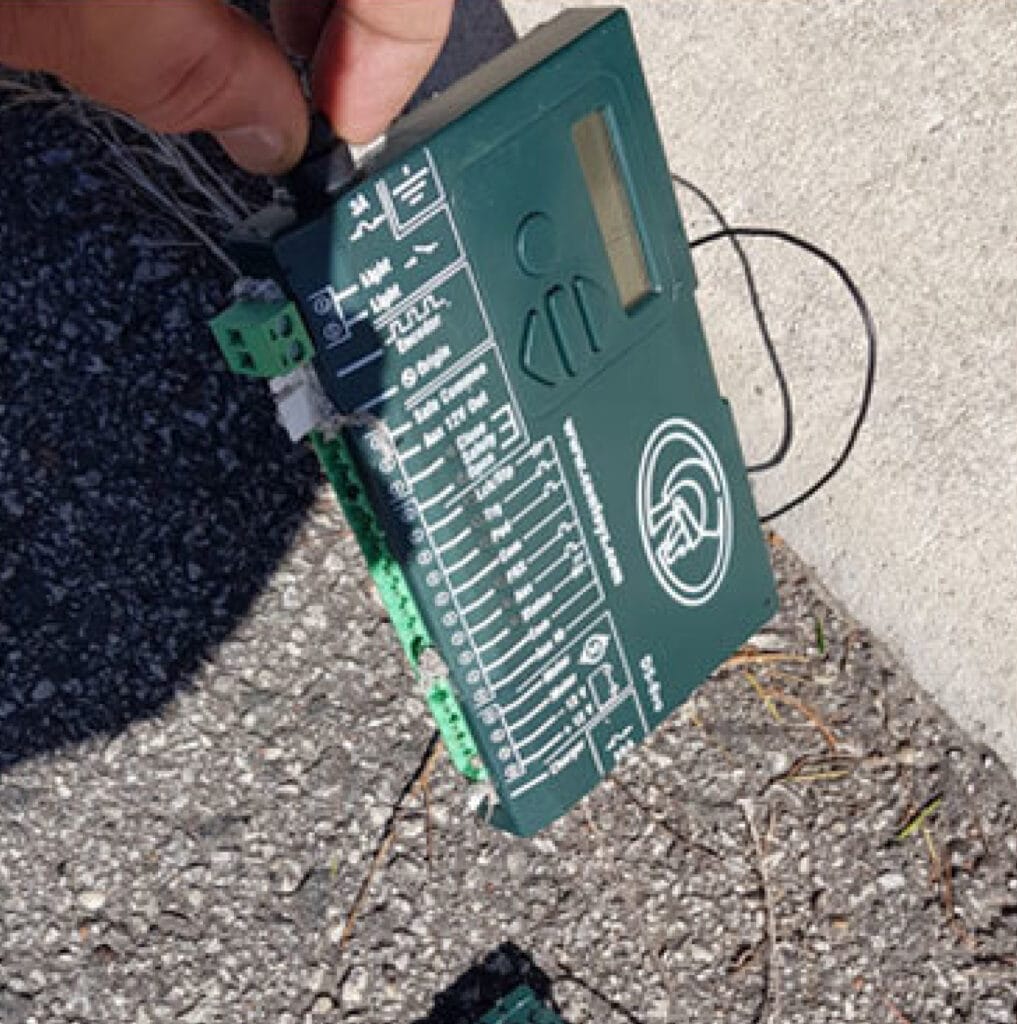
Control board faults produce erratic gate behaviour, responding inconsistently, showing error codes, opening and closing without command. Many apparent control board faults are wiring or sensor issues. We diagnose accurately before recommending replacement.

Rack and Pinion Wear
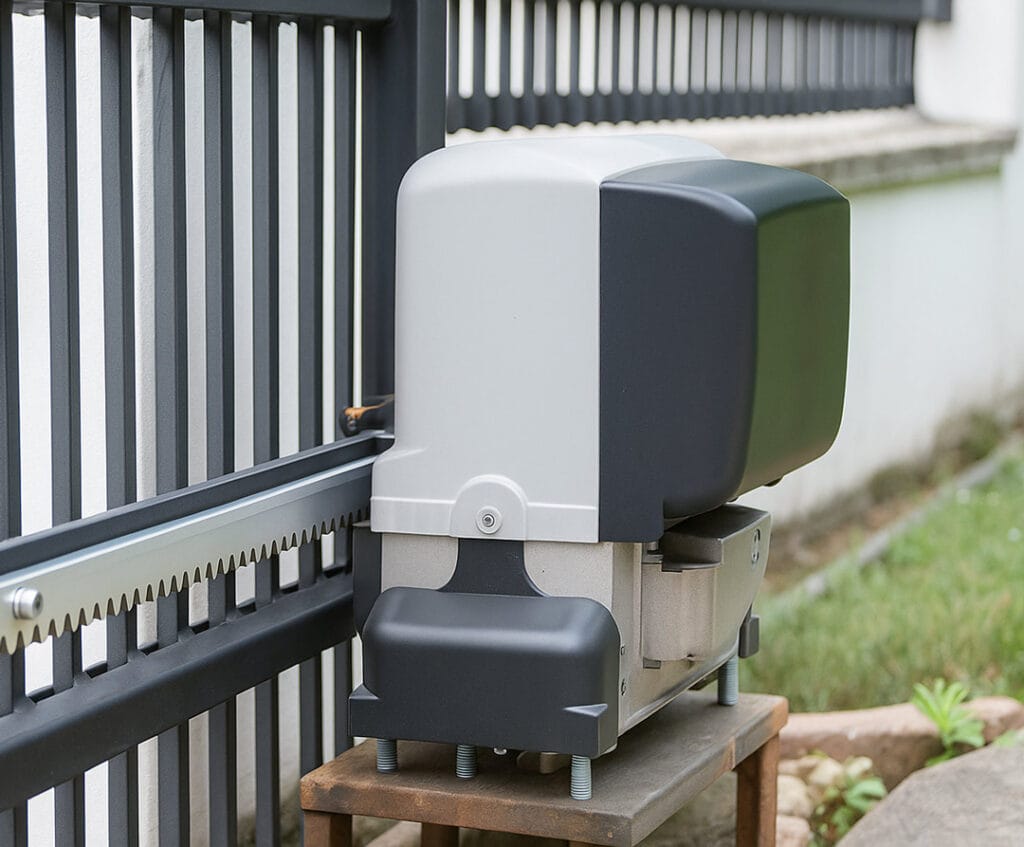
The rack is the toothed bar welded along the gate’s bottom or rear edge. The pinion is the drive gear on the motor that engages the rack to move the gate. Over time and under constant load, rack teeth wear, pinion teeth wear, and the engagement between them becomes sloppy, producing noise, jerky movement, and eventually skipping or complete disengagement.
Signs of rack and pinion wear: Grinding or clicking during gate travel, the gate jerking rather than moving smoothly, the motor engaging but the gate not moving (pinion skipping over worn rack teeth), and increased motor noise under load.
Repair: Rack replacement involves re-welding or bolting the new rack to the gate panel, a more involved repair than motor or control board work, but a straightforward one for an experienced technician. Pinion replacement is part of the motor or gearbox assembly.
Roller Wear and Guide Problems
Track system rollers: The rollers that run along the ground track support the gate panel’s weight and guide its travel. Worn rollers create friction, causing the gate to run heavy (straining the motor) and eventually binding or jamming. Roller replacement is a routine maintenance item on track systems.
Cantilever system rollers: The rollers on a cantilever gate carry the full suspended weight of the gate panel. Worn cantilever rollers typically produce vibration and noise during gate travel, and if left unaddressed, cause the gate to drop progressively until the gap between gate bottom and ground reaches a point that compromises the gate’s security function.
Track damage: Ground tracks on commercial sites are vulnerable to damage from vehicles crossing them, even at low speed, a truck tyre repeatedly crossing an improperly mounted track segment will loosen and eventually dislodge it. Track damage causes binding, misalignment, and eventually prevents the gate from travelling at all.

Safety Device and Sensor Faults
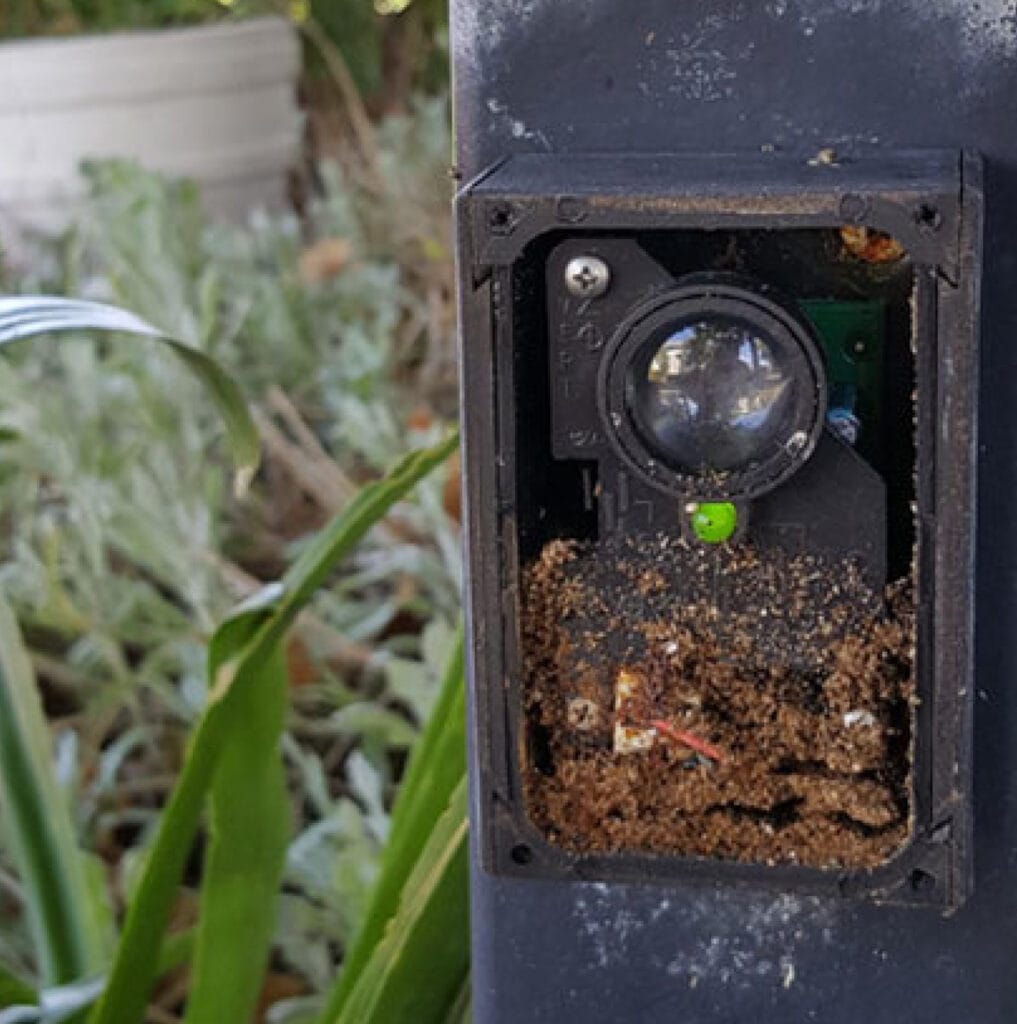
Commercial and industrial sliding gates require safety devices, loop detectors, photocell beams, safety edges, that prevent the gate from closing on a vehicle or person. Safety device faults are one of the most frequent sliding gate service calls:
Loop detector faults: The inductive loop embedded in the driveway detects vehicles to trigger opening and to hold the gate open while a vehicle is present. Loop faults cause the gate to not detect approaching vehicles (requiring manual activation) or to reopen and close repeatedly as the loop gives false readings. Loop damage from heavy vehicle traffic is common on busy commercial entries.
Photocell beam faults: Beams across the gate opening prevent closing if a person or vehicle is in the path. Misalignment, from nearby construction, cleaning, or any physical change near the gate posts, causes the beam to miss its receiver and the gate refuses to close. Realignment is a straightforward service task.
Safety edge faults: Pressure-sensitive edges on the leading edge of the gate detect contact with an obstruction and reverse the gate. Safety edge failure is safety-critical, a gate whose safety edge has failed can close on a person without reversing. We treat safety edge faults as urgent repairs.
Access Control Device Faults
RFID reader failures, remote control pairing loss, intercom communication faults, and keypad failures are among the most frequent sliding gate service calls, the gate mechanics are fine but the trigger mechanism has failed. These are often quick fixes but require correctly diagnosing whether the fault is in the access control device, its wiring to the control board, or the control board’s response to the device.
Structural and Physical Damage
Vehicle impacts, a truck or forklift striking the gate panel, a vehicle reversing into a partially open gate, cause structural damage ranging from minor panel distortion to complete gate collapse. Assessment after a vehicle impact should include not just the visible panel damage but the effect on the hinge/roller assembly, the rack and track alignment, and the post mounting (particularly for cantilever systems, where a significant impact can shift the post footings).

Sliding Gate Maintenance
Why Sliding Gates Need Regular Servicing
A commercial sliding gate cycling 50 times per day accumulates over 18,000 cycles per year. At that rate, rack and pinion wear, roller wear, track debris accumulation, and motor component fatigue all progress at a rate that makes annual-or-better servicing important, not optional. Most gate failures we attend are preceded by warning signs that a maintenance visit would have identified and resolved at a fraction of the repair cost.
Why Sliding Gates Need Regular Servicing
Mechanical system:
- Rack and pinion inspection: tooth wear, engagement quality, lubrication
- All rollers: track system or cantilever: condition, wear, bearing noise
- Guide track: alignment, cleanliness, mounting bracket condition (track systems)
- Cantilever post condition: mounting hardware, footing integrity (cantilever systems)
- Gate panel alignment: plumb, square, consistent travel path, bottom clearance
- All hardware: hinges, end stops, limit adjusters
Automation and safety:
- Motor performance: current draw, operating temperature, noise assessment
- Control board diagnostic scan and fault log review
- Limit switch verification and adjustment
- All safety devices: loop detectors, photocell beams, safety edges: function tested
- Access control devices: remote, RFID, intercom, keypad: all confirmed functional
- Battery backup test (where fitted)
Types of Sliding Gates We Repair
A single steel panel runs along a ground-level track, driven by a rack-and-pinion motor system. The most common commercial sliding gate type. Common fault patterns on track systems include track damage from vehicle crossings, debris accumulation in the track channel causing the gate to bind or jam, roller wear from constant contact with the track surface, and motor failures on high-cycle industrial sites where the original motor was undersized for actual usage.
The gate panel is suspended above the ground on rollers mounted to posts on one side of the opening, no ground track required. Standard specification for industrial sites with unsealed or gravel surfaces, heavy vehicle traffic, or uneven ground. Cantilever gates have specific failure modes that differ from track systems: roller wear and post mounting degradation are more prominent, and the counterbalance configuration of the gate panel requires correct assessment before motor specification or replacement.
Multiple panels that telescope (overlap and stack) as the gate opens, allowing a wider clear opening from less available run-back space. Less common than single-panel systems but present across urban commercial properties and established industrial sites with constrained layouts. Telescopic systems have more complex drive linkages and synchronisation requirements — faults in the synchronisation mechanism are specific to this type.
metro and South East Queensland; Acacia Ridge, Wacol, Brendale, and Yatala industrial precincts; cantilever gates frequently specified on unsealed surfaces across QLD industrial estates
cantilever gates dominate Perth’s industrial precincts given the prevalence of unsealed and gravel surfaces; Kewdale, Welshpool, Henderson, Malaga, and Bibra Lake are primary service zones; corrosion-resistant hardware standard for coastal-adjacent sites
Adelaide and Regional
metro SA; northern industrial corridor (Wingfield, Regency Park) and southern (Lonsdale)
Hobart and Tasmania
Greater Hobart and key Tasmanian commercial locations
Where We Repair Sliding Gates
Our technicians are locally based across all major Australian cities and industrial centres:

all metro suburbs; strata and commercial sliding gates across the inner suburbs and CBD fringe; high-cycle industrial gates across Western Sydney (Wetherill Park, Eastern Creek, Prestons) and South Sydney (Alexandria, Botany)
full metro coverage; industrial sliding gates across Dandenong, Laverton, Truganina, Campbellfield, Port Melbourne, and Altona; cantilever gates common across the western industrial corridor’s heavier vehicle precincts
ACT coverage; Fyshwick, Mitchell, and Hume; government and institutional sliding gate systems serviced with appropriate security-clearance protocols where required
Darwin metro with cyclone-rated service standards for all NT work
Why Choose National Entrance Systems
When your gate and door needs attention, trust National Entrance Systems to get it working quickly and correctly.
Honest Pricing & Reliable Service
It’s been a pleasure working with you and your team – professional, efficient, and great communication throughout.
- Clear pricing before work begins
- No unnecessary replacements
- Competitive rates
- Work backed by warranty
Brands We Repair and Install
We service all major sliding gate automation brands operating in Australia:

Roger
Brushless motor technology for extended service life and reduced maintenance requirements. Well-suited to high-cycle commercial applications where motor longevity is a priority. Increasingly specified in Australian commercial applications.

Centsys
The most widely deployed gate automation brand in Australian commercial and industrial applications. The D-Series sliding gate operators, D5 Evo, D10, D20, cover the full commercial weight range from light commercial panels to heavy industrial gates up to 2,000kg. The CENTSYS NERO and ET series cover swing gate and boom gate applications.
We are experienced across the complete Centsys product range and carry common Centsys parts. If you’re searching for a Centsys supplier or Centsys service provider in Sydney, Melbourne, Perth, Brisbane, Adelaide, or regional Australia, we are an experienced Centsys installer and service provider.

DEA
Italian-engineered gate automation systems with a reputation for precision and quiet operation. DEA TOM and BOX series cover commercial sliding gate applications; DEA wing series covers swing gates. Common in applications where noise and smooth operation are specified priorities.

BFT
Italian automation covering sliding gates (DEIMOS series), swing gates (PHOBOS, ARES series), and boom gates (MOOVI series). Strong commercial specification across the Australian market. BFT systems are commonly found in strata and commercial property installations across all major Australian cities.

FAAC
Italian brand with a strong presence in Australian commercial gate automation. FAAC covers the full commercial gate range, sliding gate operators (FAAC 740, 844 series), swing gate arm operators (FAAC 402, 760 series), and traffic barrier systems (FAAC 615, 620, 640 series). Well-regarded for reliability and high-cycle durability.

Nice/GDS
NICE covers residential through commercial gate automation with a strong smart integration story. The NICE ROBUS series for sliding gates and NICE WALKY for swing gates are commonly installed across Australian commercial and residential applications.
Get a Fast Quote for Your Gate Repair
Tell us about your site, the location, the application, the approximate traffic volume, and any access control requirements, and we’ll come back with a recommendation and written quote. For larger projects, we’ll arrange a free site visit first.
- 1300 044 400
- hello@nationalco.com.au
- National Entrance Systems