Introduction
Choosing the wrong automated gate for a commercial or industrial site creates problems that don’t show up until the system is in the ground. A sliding gate motor undersized for the actual vehicle volume burns out in two years rather than ten. A swing gate specified without checking the driveway slope won’t seal correctly and the operator strains on every cycle. A cantilever gate installed without engineering the post footings for the soil conditions shifts and drops out of alignment within months.
This guide covers every decision that matters for commercial and industrial automated gate installations in Australia, the gate types, how each system works, what they cost, what to look for in a specification, and how to keep them running long-term.
What Are Automated Gates?
Automated gates use electric motors, control boards, and safety sensors to open and close without manual operation. They can be triggered by remote controls, RFID cards, keypads, intercoms, vehicle detection loops embedded in the driveway, or integrated access control systems. The core benefit for commercial and industrial sites is controlled vehicle access without staffing a gate, every vehicle that enters or exits does so on an authenticated trigger, and the gate closes behind them automatically.
Automated gates are essential infrastructure for:
- Warehouses, factories, and logistics facilities requiring controlled vehicle access across multiple shifts
- Strata apartment complexes and commercial buildings managing resident and visitor parking
- Industrial estates and business parks with shared access control requirements
- Healthcare facilities, schools, and institutional sites balancing security with high throughput
- Distribution and transport hubs where gate cycling speed directly affects operational efficiency
Automated Sliding Gates
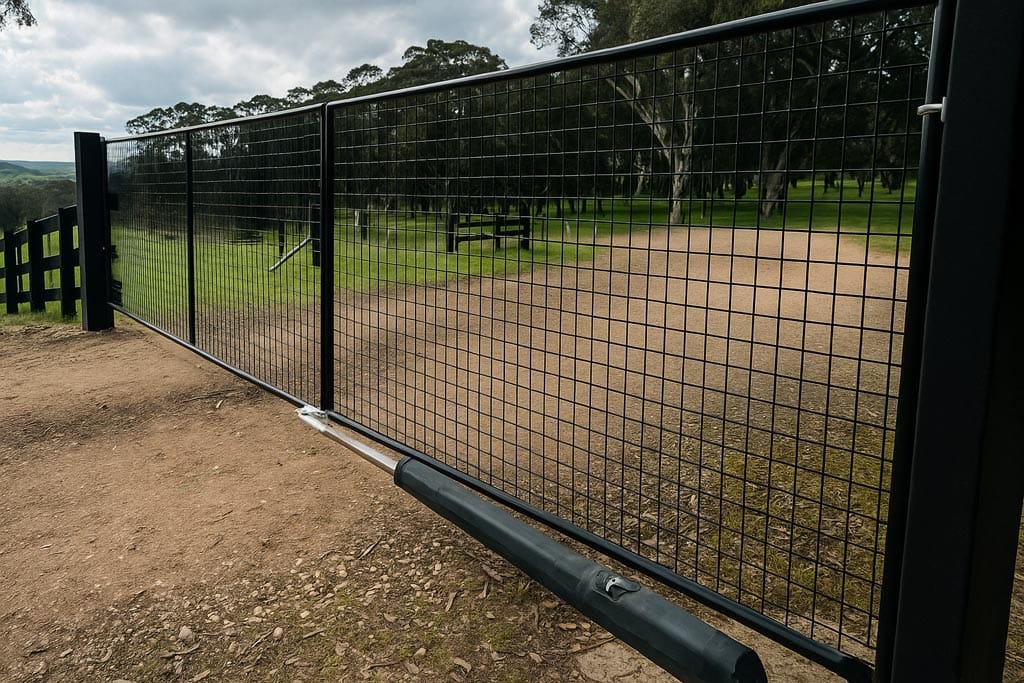
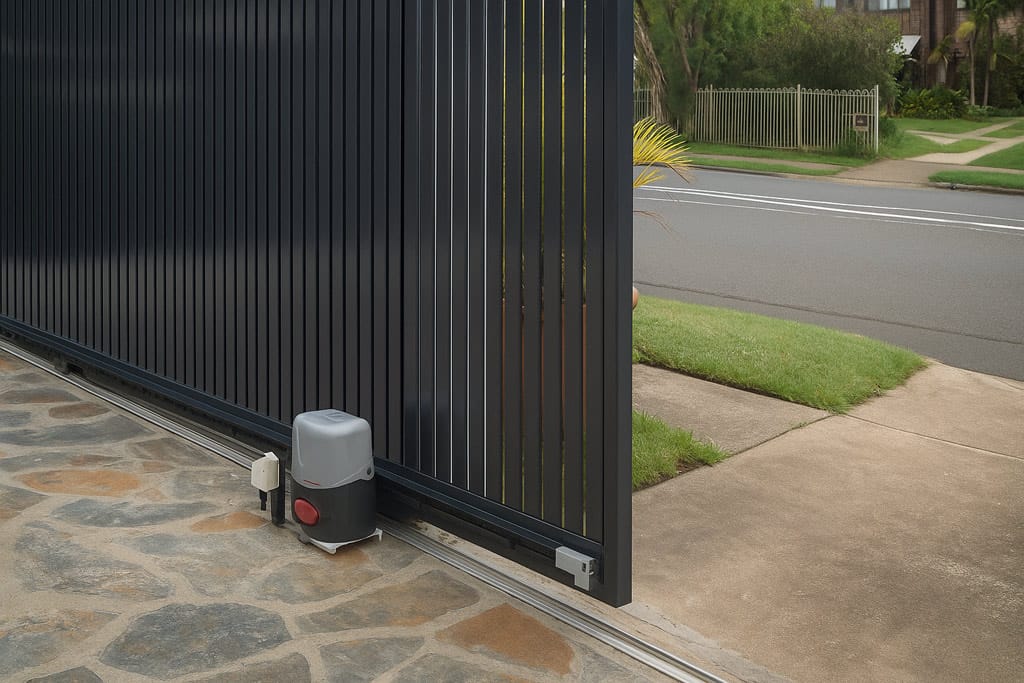
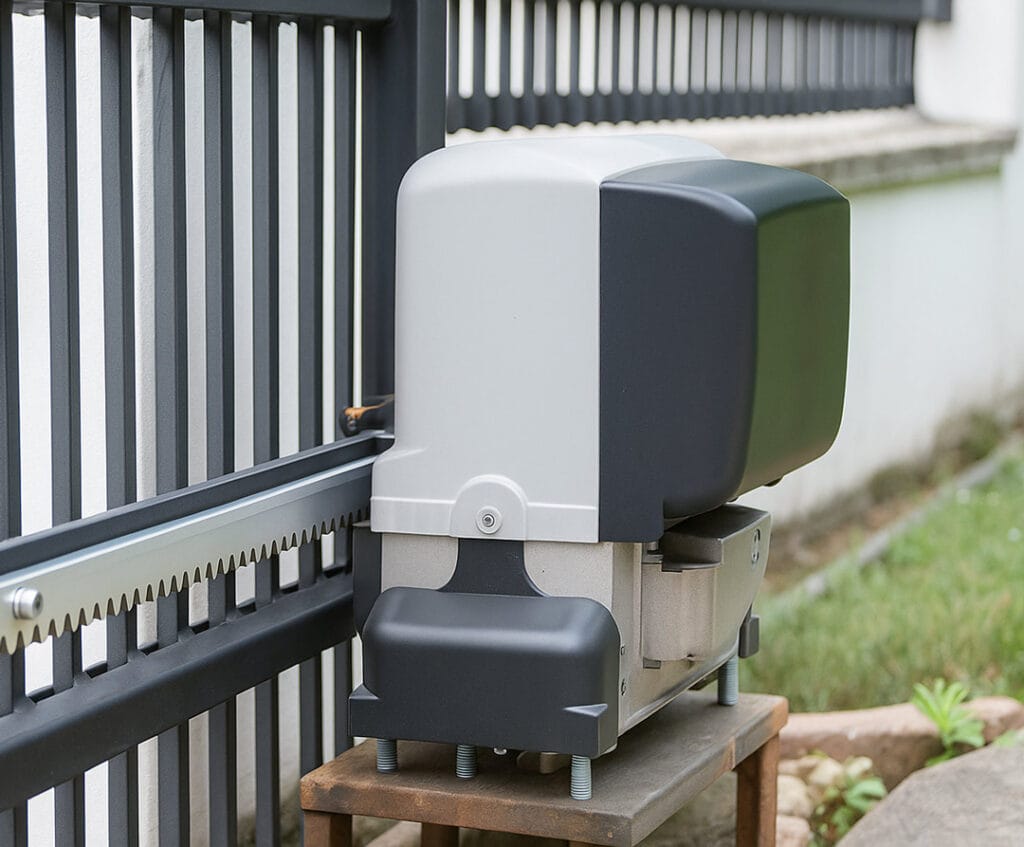
A single panel slides horizontally across the opening, driven by a rack-and-pinion motor mounted at the base of the gate. The two configurations, track-mounted and cantilever, suit different site conditions.
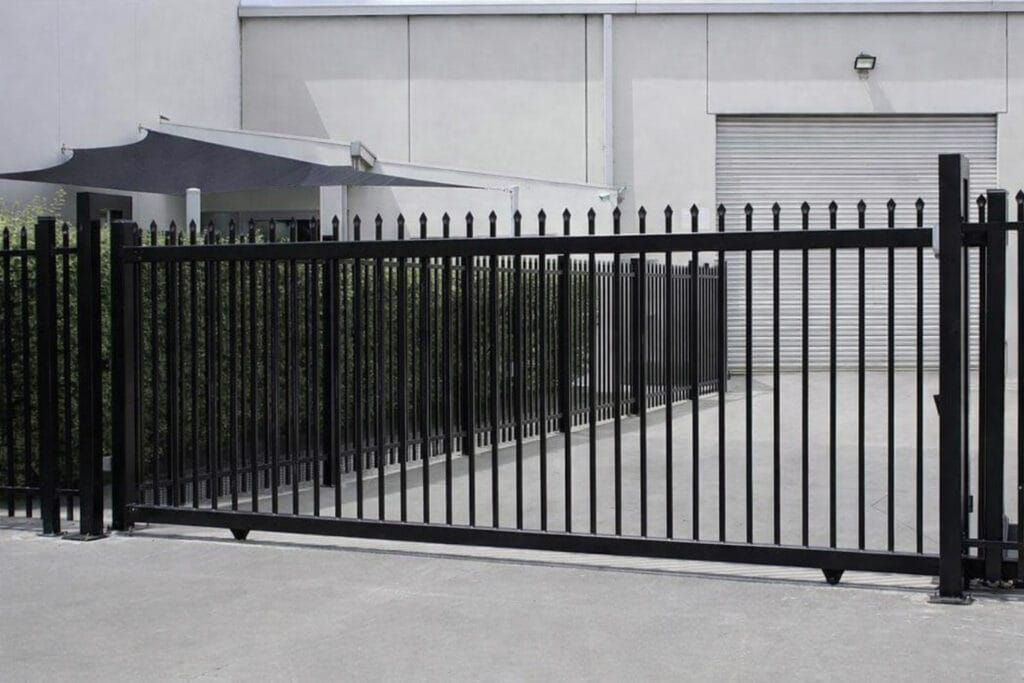
Track-mounted sliding gates
run on a ground-level steel track. They require a sealed, level surface that stays level under repeated vehicle crossings. Well-suited for sealed driveways with light to medium vehicle traffic.
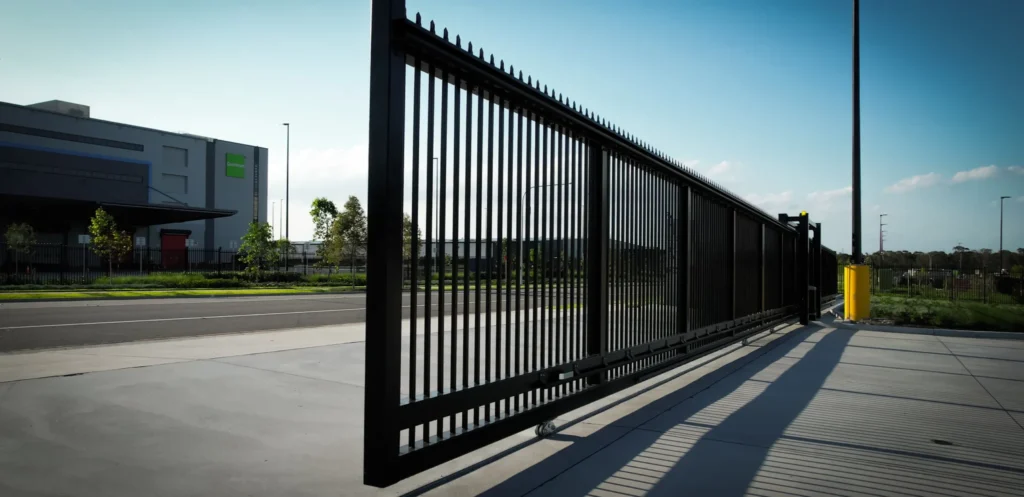
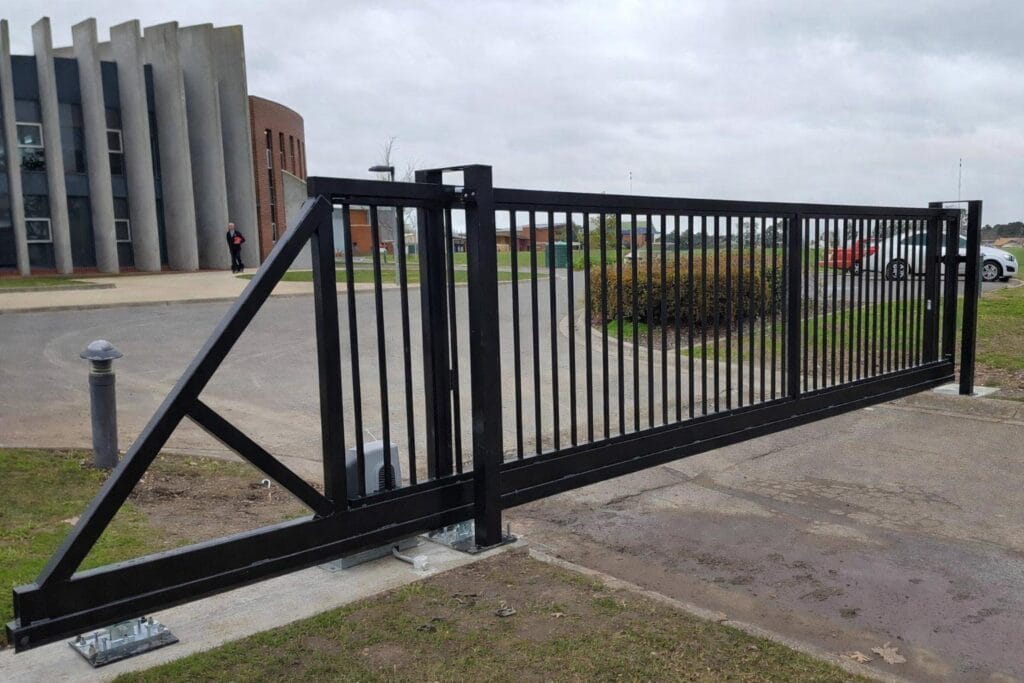
Cantilever sliding gates
are suspended above the ground on rollers mounted to posts on one side of the opening, no ground track required. The correct specification for sites with gravel or unsealed surfaces, heavy vehicle crossings, or any condition where a ground track would be damaged or clogged. Cantilever is the dominant specification across Australian industrial sites for this reason.
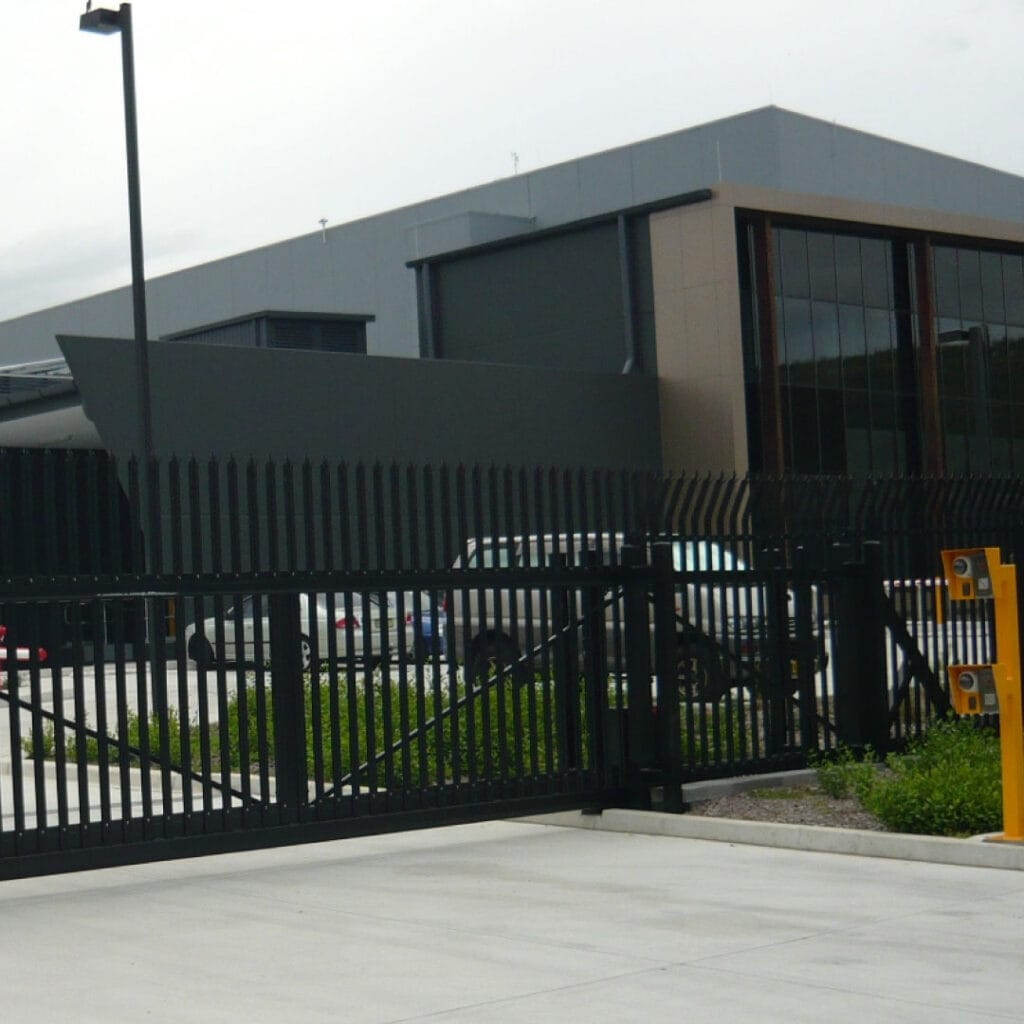
Motor selection for sliding gates
The motor must be rated for the gate panel’s weight and your site’s daily cycle volume. A Centsys D5 Evo rated for 500kg and 150 cycles per day is appropriate for a commercial office entry. A Centsys D10 or D20 — or FAAC 844 series — is the correct specification for a logistics facility gate cycling 300+ times per day under heavy vehicle traffic. Getting this wrong is the most common cause of premature motor failure on sliding gates.
Automated Swing Gates
Single or double leaf panels that pivot open on hinges, driven by electromechanical arm operators, hydraulic linear actuators, or underground (inground) mechanisms.
Articulated arm operators: the most common commercial swing gate configuration. A hinged two-part arm attaches to the gate leaf and post, pushing and pulling the leaf through its arc. FAAC, BFT, and NICE arm operators are the most widely installed across Australian commercial sites.
Hydraulic operators: preferred for heavy commercial and industrial swing gates. FAAC’s hydraulic range delivers higher power in a compact housing, significantly longer service life than electromechanical alternatives, and superior weather resistance. The correct specification for gate leaves over 4 metres wide or on high-cycle commercial entries.
Inground operators: motor mechanism concealed below the driveway at the hinge point. No visible arm or housing. Specified where the appearance of the entry is a design requirement, prestige commercial developments, institutional buildings, government facilities.
Site considerations: Swing gates require unobstructed arc clearance on the swing side. A gate that opens inward requires a driveway long enough that a waiting vehicle doesn’t block the gate’s travel path. Sloping driveways require specific operator configuration to prevent drift when the motor releases. These factors must be assessed on-site before specification.
Automated Boom Gates
A pivoting counterbalanced arm, typically 3 to 6 metres long, rises and falls to allow or deny vehicle access. The simplest and fastest-cycling automated gate type, and the standard for managed car parks, loading docks, and any high-throughput site where gate speed matters more than physical security.
Boom gates don’t provide the same physical barrier as a sliding or swing gate, a determined vehicle can drive through a boom gate arm. They are access management infrastructure, not anti-ram security barriers. For sites requiring the latter, heavy-duty rising bollards or security crash barriers are the appropriate specification.
Commercial applications: Strata car parks, commercial building parking, hospital and university car parks, logistics facility entries, industrial estate access control.
Bi-Folding Automated Gates
Two panels fold against each other as the gate opens, the left half folds left, the right half folds right, allowing a full-width clear opening from approximately half the run-back space a standard sliding gate requires. Specified for sites where gate speed is critical and available run-back is limited: emergency service vehicle access, high-throughput logistics entries, and sites where a standard sliding gate would require unacceptable driveway modifications.
Bi-folding gates operate faster than any other automated gate type, full open in 3–5 seconds compared to 10–20 seconds for a standard sliding gate on the same opening. The mechanical complexity of the folding mechanism requires more frequent maintenance than simpler gate types.
Cantilever and Vertical Lift Gates
Cantilever gates (covered under sliding gates above) are the dominant configuration for Australian industrial sites with unsealed surfaces or heavy vehicle traffic.
Vertical lift gates rise straight upward rather than sliding or swinging. Specified for sites where horizontal clearance for a sliding gate isn’t available, narrow industrial entries flanked by buildings on both sides, for example. Less common in Australian commercial and industrial applications but present in constrained urban industrial sites.
Access Control Integration
An automated gate is only as useful as its trigger system. The access control method determines who can operate the gate, how, and what records are kept. Commercial and industrial sites typically use one or more of:
RFID cards and fobs: the most common commercial gate access method. Each authorised user carries a card or fob that triggers the gate reader. Cards can be added or revoked instantly without rekeying. The standard for strata car parks and commercial office entries.
Remote controls: straightforward and inexpensive for sites with a limited, consistent user group. Rolling-code remote systems (where the code changes on every use) prevent code-copying. Most appropriate for industrial sites with a stable workforce.
Keypads: PIN-based access without the need to carry a card. Appropriate for visitor access or secondary access points where RFID management overhead isn’t warranted.
Intercom and video stations: a visitor presses a call button, a staff member or resident answers via intercom or video, and grants access remotely. Standard for strata visitor access and commercial reception entries.
Vehicle detection loops: inductive loops embedded in the driveway detect vehicles and trigger the gate to open for exit, or to hold open while a vehicle is present in the opening. Essential for preventing the gate from closing on a vehicle.
ANPR (Automatic Number Plate Recognition): cameras read vehicle number plates and match them against an authorised list. Common in managed commercial car parks where ticketless parking management is specified. Higher upfront cost but significantly reduced management overhead for large-volume car parks.
Smartphone and cloud access: increasing in new commercial and strata installations. Users operate the gate from their phone; administrators manage access remotely through a web dashboard. Brands including Centsys, BFT, and NICE all offer smart access integration with their current gate automation ranges.
Automated Gate Installation
What the Process Involves
Understanding what a professional installation involves helps set realistic expectations for timeline and site disruption.
Site assessment: Before any specification is finalised, a site assessment confirms gate type suitability, post footing requirements, power supply routing, access control placement, and any civil preparation needed. This is not optional — skipping the site assessment leads to specification errors that are expensive to correct post-installation.
Civil preparation: Concrete post footings must be poured and cured before gate installation can begin. For cantilever gates, post footings need to be engineered for the gate panel weight and the local soil conditions — sandy or clay soils require different footing designs. Allow 3–5 days for concrete to cure before gate installation.
Electrical work: Most automated gate installations require a licensed electrician to run a 240V supply to the motor and access control position. Battery backup systems require a separate circuit. Where solar power is specified for remote gate positions, the solar installation is separate to the gate installation.
Gate and motor installation: The gate panel, posts, motor, and all mechanical components are installed and aligned. This typically takes one day for a straightforward sliding or swing gate installation.
Access control commissioning: RFID readers are programmed, remote controls are paired, intercoms are configured, and loop detectors are calibrated. For integrated systems with cloud access management, this stage involves software configuration as well as hardware.
Safety device testing: All obstacle detection systems — photocell beams, safety edges, and loop detectors — are tested to confirm they function correctly before handover. This is a mandatory step for compliance with Australian Standards.
Total timeline: 1–3 weeks from initial site assessment to commissioned gate, depending on civil preparation requirements, electrical works, and access control complexity.


Automated Gate Repair and Maintenance
Automated gates require regular maintenance to perform reliably across their service life. A commercial sliding gate cycling 100 times per day accumulates over 36,000 cycles per year. At that rate, rack and pinion wear, roller wear, motor component fatigue, and safety device calibration drift all progress at a rate that makes scheduled maintenance essential, not optional.
Common automated gate faults:
Motor failure, the most frequent emergency callout. Slow or laboured gate movement, grinding or straining under load, stopping mid-travel, or complete unresponsiveness. Often preceded by gradually increasing noise and slower operation that regular servicing would catch first.
Control board and wiring faults, erratic gate behaviour, error codes, responding to some commands but not others. UV degradation of outdoor cabling, moisture ingress into cabinet enclosures, and rodent damage are all common causes in Australian outdoor installations.
Safety device failure, photocell beams and safety edges that prevent the gate closing on a vehicle or person. A failed safety device that prevents closing is a nuisance. A safety device that has failed without being detected, allowing the gate to close on an obstruction, is a safety and liability issue.
Access control faults, RFID reader failures, remote control pairing loss, loop detector malfunctions. The gate mechanics are often fine; the trigger system has failed.
Physical damage, vehicle impacts on gate panels, operators, and posts. Most commercial automated gate operators incorporate a release mechanism that limits damage on impact; the extent of repair required depends on whether the impact has reached the motor and mechanism.
Recommended maintenance intervals:
- High-cycle industrial and logistics gates (100+ cycles/day): every 3 months
- Commercial and strata gates (20–100 cycles/day): every 6 months
- Light commercial (under 20 cycles/day): annually
Understanding what a professional installation involves helps set realistic expectations for timeline and site disruption.
Site assessment: Before any specification is finalised, a site assessment confirms gate type suitability, post footing requirements, power supply routing, access control placement, and any civil preparation needed. This is not optional, skipping the site assessment leads to specification errors that are expensive to correct post-installation.
Civil preparation: Concrete post footings must be poured and cured before gate installation can begin. For cantilever gates, post footings need to be engineered for the gate panel weight and the local soil conditions, sandy or clay soils require different footing designs. Allow 3–5 days for concrete to cure before gate installation.
Electrical work: Most automated gate installations require a licensed electrician to run a 240V supply to the motor and access control position. Battery backup systems require a separate circuit. Where solar power is specified for remote gate positions, the solar installation is separate to the gate installation.
Gate and motor installation: The gate panel, posts, motor, and all mechanical components are installed and aligned. This typically takes one day for a straightforward sliding or swing gate installation.
Access control commissioning: RFID readers are programmed, remote controls are paired, intercoms are configured, and loop detectors are calibrated. For integrated systems with cloud access management, this stage involves software configuration as well as hardware.
Safety device testing: All obstacle detection systems, photocell beams, safety edges, and loop detectors, are tested to confirm they function correctly before handover. This is a mandatory step for compliance with Australian Standards.
Total timeline: 1–3 weeks from initial site assessment to commissioned gate, depending on civil preparation requirements, electrical works, and access control complexity.
Choosing the Right Automated Gate
Key Decisions
Gate type vs. site conditions: Sliding and cantilever gates for industrial sites with heavy vehicles or unsealed surfaces. Swing gates where arc clearance is available and traffic volumes are moderate. Boom gates for high-throughput vehicle management where gate speed is the priority.
Motor duty cycle rating: The single most important specification decision. The motor must be rated for your site’s actual daily cycle volume — not the manufacturer’s default or a residential standard applied to a commercial application.
Access control method: Driven by who needs access, how often, and what administrative overhead is acceptable. RFID for strata and commercial; remote control for stable industrial workforces; ANPR for high-volume managed car parks.
Environmental conditions: Perth’s coastal salt air, Queensland’s heat and UV, Melbourne’s winter cold — each creates specific hardware specification requirements. A mainland Australian specification applied without modification to a Perth coastal site will have a shorter service life than one that accounts for the corrosive environment.
Power and backup: Mains power with battery backup is the standard for most commercial and industrial installations. Solar power for remote gate positions without mains access. Confirm power supply availability and routing before finalising specification.
Get a Fast Quote for Your Gate Repair
Tell us about your gate, the brand, symptoms, and your location, and we’ll come back to you with a clear, no-obligation quote. For urgent faults, call us directly for priority scheduling.
- 1300 044 400
- hello@nationalco.com.au
- National Entrance Systems